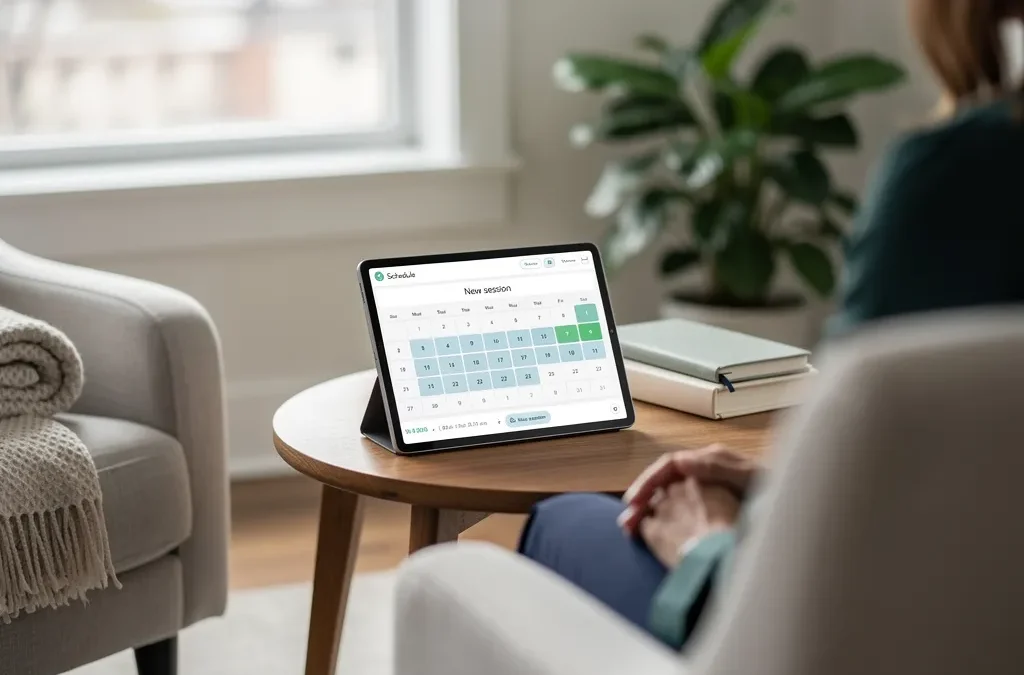
Implementing an online booking system requires HIPAA-compliant scheduling software integrated with LocalBusiness schema markup for therapist websites. Mental Marketing deploys structured data types, FAQPage and LocalBusiness, to boost local search visibility. This approach streamlines client intake while maintaining confidentiality, supporting practices in multiplying bookings 2-5 times within weeks.
- HIPAA-compliant scheduling software requires strict controls over how client healthcare information is accessed and shared.
- Informed consent must cover data captured through online scheduling platforms, not just clinical treatment.
- Intake forms should collect only minimum necessary information to reduce exposure risk while keeping booking straightforward.
- Automated synchronization with calendar apps prevents double bookings that erode client confidence and waste billable hours.
What Does a HIPAA-Compliant Booking System Require?
A HIPAA-compliant booking system requires strict controls over how client healthcare information is accessed and shared. HIPAA enforces strict rules about how clients' healthcare information is accessed and shared, making compliance a foundational requirement for any digital tool. Mental health professionals need tools that protect patient privacy while making the booking process easy for clients.
We evaluate every scheduling platform against four non-negotiable standards before recommending it to a practice.
What Are the Core Compliance Requirements?
Follow these steps in order when implementing a compliant booking system:
- Obtain informed consent from every client before capturing personal health information through the online scheduling platform.
- Maintain confidentiality throughout the entire client interaction process, from first booking to session completion.
- Use secure platforms to collect and store all scheduling data, feedback, and client records.
- Verify access controls so only authorized practitioners and staff can view client information.
Informed consent extends beyond clinical treatment. It covers the data captured through online scheduling platforms as well. A client who books an appointment shares protected information the moment they submit their name, contact details, and reason for seeking care.
How Does Booking Setup Affect Compliance?
Booking-setup-therapy decisions directly shape compliance outcomes. We configure intake forms to collect only the minimum necessary information. This reduces exposure risk while keeping the booking process straightforward for clients.
Our blueprint-onboarding process integrates these compliance checks into every implementation. The booking-blueprint-implementation phase includes a full review of consent language, data storage locations, and access permissions. Client-acquisition-setup never compromises confidentiality for convenience.
A well-designed therapist intake landing page supports compliant booking by presenting consent clearly before any data collection begins. Secure platforms protect both the practice and the client throughout the scheduling journey.
Why Should Your Practice Automate Client Intake?
Automating client intake protects your practice from the hidden costs of manual scheduling. Mental health professionals lose billable hours and clinical focus when administrative tasks consume their day. Efficient appointment scheduling in mental health care supports clients' access to critical services when they need them most. Without automation, your practice carries the cost as unrecovered staff time and missed revenue.
Mental health professionals often juggle complex caseloads, last-minute cancellations, and sensitive client needs that demand flexibility and precision. A manual system cannot scale to meet these demands. Our booking-blueprint-implementation approach replaces fragmented workflows with a unified, HIPAA-compliant intake system. We design this system to protect patient data at every touchpoint.
What Happens When Scheduling Falls Behind?
Without the right scheduling approach, therapists risk burnout while clients experience delays in care. A single missed intake call often means a prospective client seeks help elsewhere. Research published in Health Affairs Scholar shows that over 1 billion outpatient visits occur annually in the U.S., each requiring appointment scheduling. Every one of those appointments represents a scheduling decision that manual processes handle poorly at scale.
How Does Automation Improve Client Onboarding?
Effective therapist intake landing pages are essential for mental health practices seeking to improve client onboarding and increase lead generation. Our booking-setup-therapy framework integrates these pages directly with your scheduling system. This integration eliminates double data entry. It also reduces the abandonment that occurs when clients face multi-step manual booking.
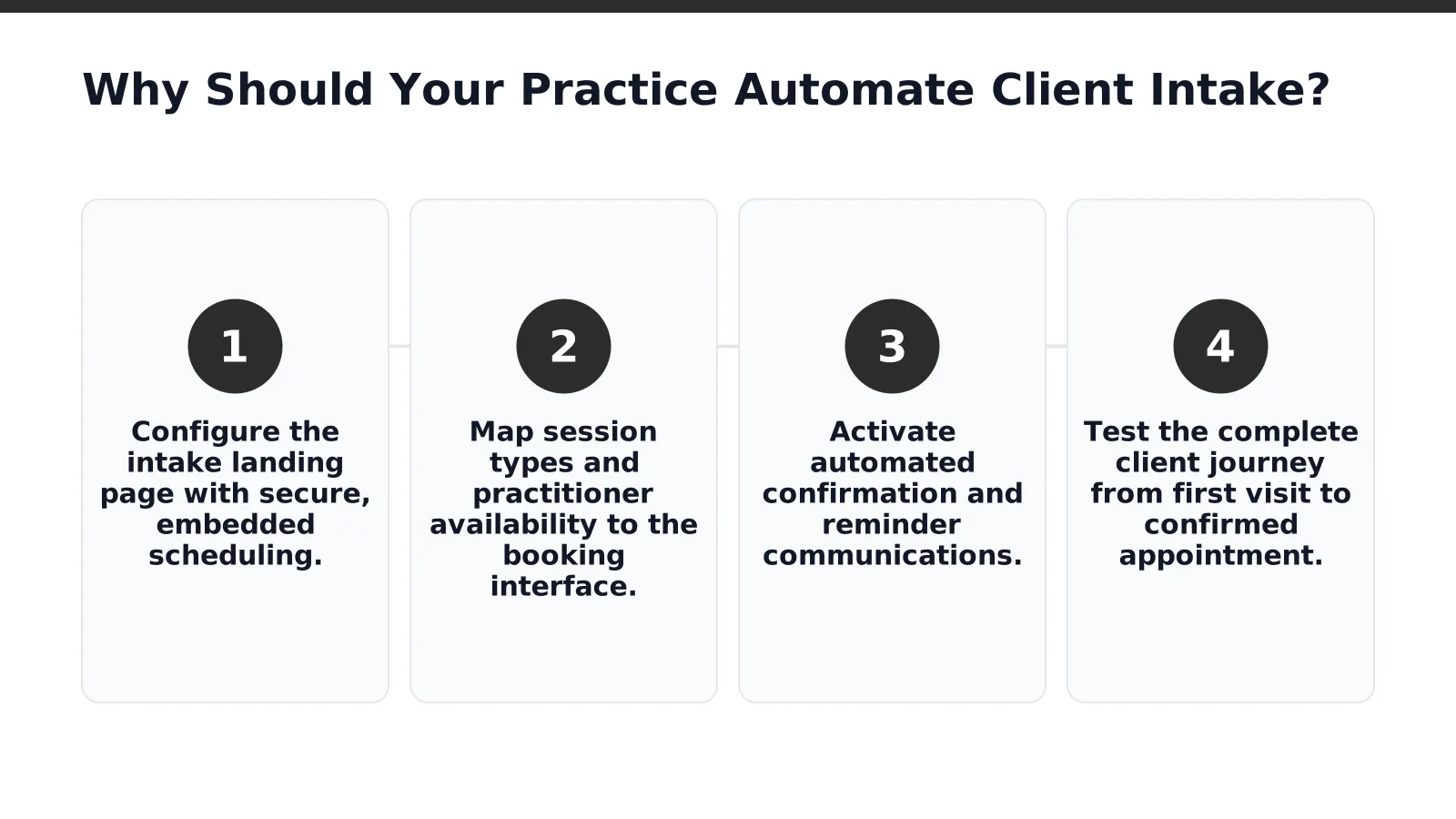
[Mental Marketing Pros](https://mentalmarketingpros.com/) builds client-acquisition-setup sequences that convert website visitors into scheduled patients. The blueprint-onboarding process follows a structured sequence:
- Configure the intake landing page with secure, embedded scheduling.
- Map session types and practitioner availability to the booking interface.
- Activate automated confirmation and reminder communications.
- Test the complete client journey from first visit to confirmed appointment.
Each step removes friction that delays care. Our team verifies compliance at every stage. The result is a system that fills your calendar while you remain focused on clinical work.
How Do You Select the Right Scheduling Platform?
Selecting a scheduling platform requires evaluating three core capabilities: secure client data management, automated calendar synchronization, and flexible booking accessibility. A platform lacking any of these elements creates compliance risks and operational friction that cost practices both revenue and client trust. We prioritize platforms that meet HIPAA-compliant standards from day one.
What Features Protect Client Data During Scheduling?
The platform must organize client information securely while allowing practices to customize session types and manage practitioner schedules. Secure payment solutions for session fees become non-negotiable when handling sensitive financial and health data together. We also require SMS or email delivery for confidential appointment confirmations and reminders, ensuring every communication channel maintains the same privacy standards as the therapy room itself.
How Does Automation Prevent Scheduling Errors?
Automated synchronization with calendar apps prevents double bookings, a problem that erodes client confidence and wastes billable hours. The system should sync appointments instantly across all practitioner calendars. This integration eliminates the manual reconciliation that introduces errors into even the most carefully managed schedules.
Can Clients Book Outside Business Hours?
Clients need to book appointments day or night. A platform restricted to office hours misses the moment a prospective client decides to seek help. We configure scheduling systems for 24/7 accessibility while maintaining the same security protocols that govern daytime operations. This constant availability converts more initial inquiries into scheduled sessions without adding administrative burden to the practice.
Our booking-blueprint-implementation process evaluates each platform against these criteria before any configuration begins. The booking-setup-therapy workflow then maps session types, practitioner availability, and intake requirements directly into the chosen system. This structured approach to client-acquisition-setup ensures the scheduling tool functions as a growth engine rather than a simple calendar. Every blueprint-onboarding engagement includes platform selection guidance because the wrong scheduling software undermines every subsequent marketing investment.
What Steps Prepare Your Practice for Online Booking?
Preparing a mental health practice for online booking requires a structured, ethical approach. We focus on three foundational steps that protect client confidentiality while maximizing conversion. Skipping any single step introduces friction that costs practices new client relationships every week.
What role does the intake landing page play in online booking?
The intake landing page functions as the initial point of contact for prospective clients. We design these pages to optimize user experience and conversion from the very first visit. A poorly constructed page loses potential clients before they ever see a calendar.
How do we implement a compliant booking-setup-therapy workflow?
- Audit current client acquisition channels. Effective lead generation relies on SEO best practices, content marketing, and regular client growth audits. We identify exactly where prospective clients drop off before scheduling.
- Integrate appointment booking directly into the intake page. Optimized client onboarding includes appointment booking integrations and mobile-responsive design for seamless user access. We embed HIPAA-compliant scheduling tools that sync with your existing calendar.
- Build ethical review collection into the scheduling sequence. Mental health practices must collect reviews without exposing protected health information. We configure automated prompts that request feedback after sessions without revealing any clinical details.
What does a complete blueprint-onboarding process include?
Our booking-blueprint-implementation connects every element into one system. The intake page captures lead information securely. The booking tool confirms appointments instantly. The review sequence builds social proof without compliance risk. This integrated client-acquisition-setup eliminates the gaps where competitors capture your potential clients. At Mental Marketing Pros, we configure each component to work together from day one.
How Do You Configure the Booking Workflow Correctly?
Correct booking workflow configuration starts with defining session types that match every therapeutic service a practice offers. Mental Marketing Pros structures each workflow to eliminate scheduling conflicts while protecting client confidentiality through HIPAA-compliant communication channels.
What session types should a therapy booking workflow include?
Session types must reflect the full range of services provided. Customize appointment categories for mental health counseling, physical therapy, and holistic wellness offerings. Each session type requires its own duration, practitioner assignment, and intake requirements.
We configure the workflow in four sequential steps:
- Define session categories. Map every service to a distinct appointment type with accurate durations and buffer times between sessions.
- Assign practitioner availability. Link each session type to the appropriate clinician's calendar, accounting for part-time schedules and supervision blocks.
- Activate calendar synchronization. Sync appointments with calendar apps automatically to prevent double bookings across all practitioner schedules.
- Configure confidential reminders. Set SMS and email triggers for appointment confirmations and reminders that maintain client privacy without exposing sensitive details.
How does the system prevent scheduling errors?
Automatic synchronization forms the backbone of error prevention. The system syncs every booking across integrated calendars instantly. Clients never encounter a double booking. This reliability creates a safe, predictable experience that builds trust from the first interaction.
Booking-setup-therapy workflows demand precision. We layer validation rules that block overlapping appointments before confirmation. The booking-blueprint-implementation process includes testing each rule against real scheduling scenarios. A missed conflict erodes client confidence immediately.
Client-acquisition-setup depends on this reliability. Prospective clients who hit a scheduling error abandon the intake process. Our blueprint-onboarding sequence verifies every workflow element before launch. Secure SMS and email delivery ensures appointment details reach clients without compromising confidentiality. The result is a booking system that operates flawlessly while upholding the ethical standards mental health practices require.
How Do You Integrate Booking with Your Marketing Funnel?
Booking integration transforms a marketing funnel from a passive information channel into an active client-acquisition engine. Every touchpoint must guide prospective clients toward a scheduled session without friction or privacy compromise. Without this integration, practices lose qualified leads who abandon the process when booking feels disjointed or insecure.
Booking-blueprint-implementation begins with the intake landing page. This page functions as the initial point of contact for prospective clients and must be optimized for conversion. We design these pages with strategic call-to-action placements and professional design that builds immediate trust. A HIPAA-compliant booking interface embedded directly on the landing page eliminates the dangerous gap between interest and action.
What technical elements connect booking to local search visibility?
Three core local ranking signals drive therapist visibility: Google Business Profile, schema markup, and reviews. Mental Marketing Pros implements schema markup with FAQ and LocalBusiness structured data to strengthen local visibility for therapist websites. This structured data clarifies content for search engines through rich snippets, making booking links appear directly in search results.
Booking-setup-therapy requires seamless calendar synchronization. We configure appointment types, practitioner schedules, and automated confirmation workflows that prevent double bookings. The system sends secure SMS or email reminders while maintaining full confidentiality.
How does the intake page convert visitors into booked clients?
Engaging landing pages use interactive features and clear value propositions to boost conversions. Our client-acquisition-setup process embeds the booking widget above the fold. Visitors see available times immediately. They book without navigating away or calling during office hours.
Blueprint-onboarding then sequences automated follow-up communications. Confirmation emails include session preparation instructions. Reminder sequences reduce no-shows. Each automated touchpoint reinforces the professional, trustworthy experience that began with the first search query. The entire funnel operates continuously, capturing intent and converting it into scheduled care without adding administrative burden to clinical staff.
What Mistakes Undermine Your Booking System Implementation?
Mental health practices lose clients and risk compliance violations when booking system implementation skips critical safeguards. A flawed booking-blueprint-implementation creates gaps that damage trust, delay care, and expose practices to regulatory penalties. Research published in Health Affairs Scholar documents that over 1 billion outpatient visits occur annually in the U.S., each requiring appointment scheduling. Every scheduling failure represents a missed therapeutic connection.
Why Does Skipping Informed Consent Create Compliance Risk?
Failing to obtain informed consent before collecting client information through the booking process violates HIPAA requirements. Our booking-setup-therapy protocols mandate explicit consent at the first data-collection touchpoint. Without this step, practices collect protected health information without authorization. The liability compounds with every form submission.
How Does Poor Calendar Integration Sabotage Your Schedule?
A system that does not sync with calendar apps leaves practices vulnerable to double bookings. Two clients arrive for the same slot. One leaves frustrated. The therapeutic relationship fractures before it begins. Automated synchronization prevents these conflicts entirely.
What Happens When Confidentiality Breaks Down in Scheduling?
Practices that do not maintain confidentiality throughout the scheduling process risk non-compliance. Intake forms transmitted over unsecured channels expose sensitive client data. Our client-acquisition-setup framework requires encrypted collection and storage at every stage. A single breach triggers reporting obligations and erodes community trust.
Why Does Rigid Scheduling Drive Client Loss?
Without a flexible scheduling approach, therapists risk burnout while clients experience delays in care. Rigid time blocks ignore the reality of crisis intervention and varying session needs. A blueprint-onboarding process builds adaptability into the system from day one. Practices that convert more visitors into booked sessions understand that scheduling flexibility directly supports therapist conversion rate optimization. Every missed appointment represents unrecovered revenue and an untreated client.
How Do You Measure Success and Scale Your System?
Mental Marketing measures success through systematic client growth audits and booking volume metrics. Scaling requires a structured framework that transforms initial wins into sustained, long-term growth.
What Metrics Define a Successful Booking System?
We track three core indicators. First, booking volume growth shows direct system performance. Second, client acquisition cost trends reveal efficiency gains over time. Third, waitlist velocity measures demand against capacity. Without regular audits, practices miss early warning signs of stagnation. These audits expose bottlenecks before they erode your referral pipeline.
How Do You Scale Without Compromising Care Quality?
Scaling ethically demands preparation. We support mental health clinics by building waitlists or devising strategies for managed practice expansion. A waitlist converts latent demand into scheduled sessions. It also protects clinician bandwidth during growth phases.
Our booking-blueprint-implementation follows a clear sequence:
- Audit current booking data and identify conversion gaps.
- Configure booking-setup-therapy workflows that match your session types and clinician availability.
- Launch client-acquisition-setup campaigns targeting your ideal patient demographics.
- Execute blueprint-onboarding with your team to standardize intake and follow-up protocols.
The Wellness Booking Blueprint helps practices multiply their bookings, growing their client base 2 to 5 times. This growth compounds when paired with retention systems. Our strategies are designed not just for immediate visibility but for sustained, long-term growth. Scaling fails when practices chase volume without infrastructure. We build the infrastructure first.
What does a HIPAA-compliant booking system require?
Strict controls over how client healthcare information is accessed and shared, plus informed consent covering data captured through online scheduling platforms.
How does booking setup affect compliance?
Intake forms collect only minimum necessary information to reduce exposure risk. The blueprint-onboarding process reviews consent language, data storage locations, and access permissions.
Why should your practice automate client intake?
Automating client intake protects your practice from hidden costs of manual scheduling and prevents double bookings that erode client confidence and waste billable hours.
Implementing an online booking system requires a structured approach that prioritizes compliance, calendar synchronization, and automated workflows. A practice that follows this sequence (auditing current data, configuring secure scheduling, launching targeted campaigns, and standardizing intake protocols) positions itself for sustained growth. The decision to implement these safeguards determines whether the system becomes a reliable client acquisition tool or a source of compliance risk and missed therapeutic connections.