Collecting testimonials ethically requires written consent, strict confidentiality, and HIPAA compliance. Mental Marketing never solicits feedback from current clients, only former ones. We showcase testimonials using schema markup for local search visibility, ensuring reviews appear in Google results while protecting patient privacy and adhering to APA and ACA ethical codes.
Written consent must detail what information the former client agrees to share and where it appears.
Practices must only solicit testimonials from former clients whose treatment concluded at least six months prior.
Anonymity serves as the default safeguard, letting clients choose a first name, initials, or no identifier.
Schema markup with review markup strengthens local search visibility for therapist websites.
What Does Ethical Testimonial Collection Require?
Ethical testimonial-compliance begins with a single non-negotiable rule. Therapists must obtain informed consent from clients before sharing any personal health information in therapy-testimonials. HIPAA enforces strict rules about how clients' healthcare information is accessed and shared. Without documented consent, a practice risks regulatory penalties and irreparable damage to client trust.
Our approach at Mental Marketing Pros embeds these safeguards into every review-generation workflow. We build systems that are HIPAA-compliant by design, never as an afterthought.
What consent documentation is required before publishing a testimonial?
Written authorization must detail exactly what information the former client agrees to share. The document specifies where the testimonial appears and for how long. It also confirms the client understands their right to revoke consent at any time.
How do secure platforms protect the testimonial process?
Practices must maintain confidentiality throughout the review process and use secure platforms to collect and store feedback. Encrypted collection tools prevent unauthorized access to protected health information. These platforms also create audit trails that demonstrate compliance during a board review or investigation.
The collection process itself follows a strict sequence:
Identify former clients whose treatment concluded at least six months prior.
Send a neutral, private request explaining the testimonial's purpose and scope.
Provide the written consent form and answer all questions before proceeding.
Collect the feedback through an encrypted, HIPAA-compliant portal.
Review the submitted content to verify no protected information appears inadvertently.
Practices should avoid soliciting testimonials from current clients. This boundary protects the therapeutic relationship from perceived coercion. Former clients can speak freely without worrying about how their words might affect ongoing care. Our ethical review generation framework transforms these requirements into a repeatable, defensible system. Client-success-stories and testimonial-case-studies then become powerful assets that never compromise the confidentiality at the heart of clinical work.
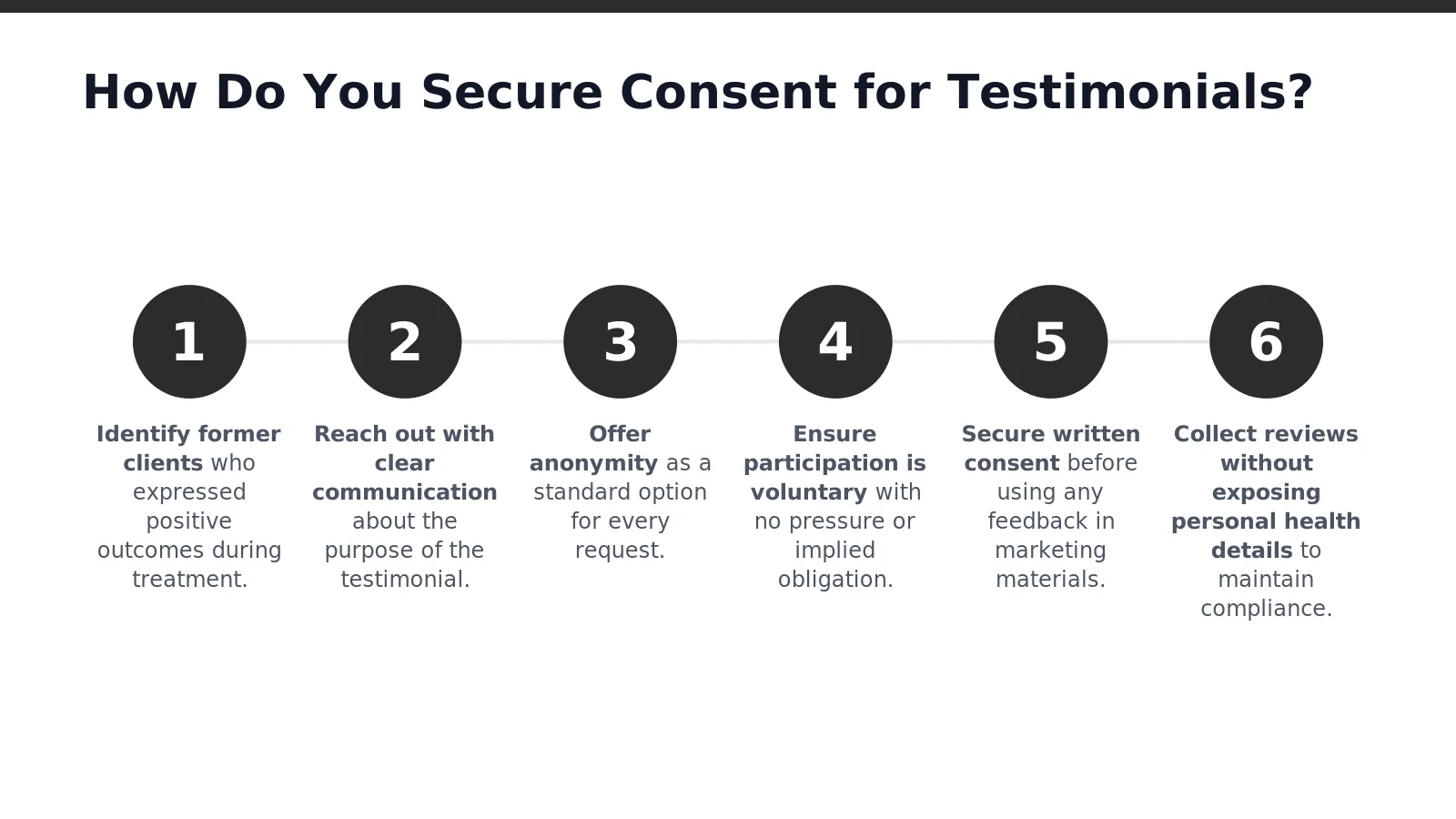
How Do You Secure Consent for Testimonials?
Securing consent for therapy-testimonials requires written authorization before any client feedback appears in marketing materials. The process protects client confidentiality and keeps the practice aligned with HIPAA-compliant standards. Without documented consent, a practice risks ethical violations and loss of professional standing.
We follow a structured sequence for every testimonial request. Each step prioritizes voluntary participation and transparent communication.
What Are the Prerequisites Before Requesting a Testimonial?
Confirm the individual is a former client, not a current one. Soliciting testimonials from current clients violates ethical guidelines. Verify that the therapeutic relationship has formally ended before any outreach occurs.
Step-by-Step Consent Process
Identify former clients who expressed positive outcomes during treatment.
Reach out with clear communication about the purpose of the testimonial.
Offer anonymity as a standard option for every request.
Ensure participation is voluntary with no pressure or implied obligation.
Secure written consent before using any feedback in marketing materials.
Collect reviews without exposing personal health details to maintain compliance.
What Should the Written Consent Include?
Written consent documents the client's explicit approval for specific uses of their words. The document states where the testimonial will appear and whether identifying details remain. We maintain confidentiality throughout this process and follow HIPAA guidelines at every stage.
How Do We Protect Client Identity?
Anonymity serves as the default safeguard for testimonial-compliance. Clients choose whether to use a first name, initials, or no identifier at all. This approach preserves the therapeutic value of client-success-stories without compromising privacy.
Where Should You Display Client Success Stories?
Client success stories must appear where potential therapy clients already look for validation. Displaying therapy-testimonials in high-traffic digital spaces builds trust while maintaining the ethical boundaries our profession demands. Without strategic placement, practices lose the conversion power these authentic narratives provide. The most effective locations include website properties, public review platforms, and technically enhanced local search results.
Does placing testimonials on service pages increase conversions?
Service-specific client-success-stories create immediate relevance for visitors evaluating particular therapy offerings. A testimonial about anxiety treatment resonates differently on a general homepage than it does beside details of a practice's anxiety therapy program. We place narratives on individual service pages where the context matches the reader's intent. This alignment reduces hesitation by demonstrating specific outcomes.
How do public review platforms affect therapist visibility?
Public platforms like Google Reviews boost visibility substantially, according to the Ultimate Guide to Using Testimonials in Therapy Practice. Prospective clients encounter these reviews during their initial search before ever visiting a practice website. A strong review ecosystem, combined with an optimized Google Business Profile, functions as a core local ranking signal. Practices without this foundation forfeit discoverability in "therapist near me" searches.
Technical implementation multiplies the impact of strategic placement. Schema markup with review markup strengthens local search visibility for therapist websites by clarifying content for search engines. Our approach to testimonial-compliance ensures every display method, from website widgets to structured data, meets HIPAA requirements and professional ethics codes.
Can social media ethically showcase client feedback?
Social media platforms offer high-traffic channels for sharing testimonial-case-studies when strict consent protocols govern every post. We establish written permission frameworks before any client narrative reaches an Instagram feed or Facebook page. These platforms reach audiences who may never encounter a practice through traditional search, expanding ethical outreach without compromising confidentiality.
Strategic placement also considers technical elements many practices overlook. Schema markup combined with review markup directly determines local visibility for therapist searches, outperforming generic content strategies. A cohesive brand identity across platforms reinforces credibility. For practices strengthening their visual and messaging presence, our branding and identity services support consistent, trustworthy presentation.
How Do You Build Testimonial Case Studies?
Building testimonial case studies requires a structured process that protects client confidentiality while demonstrating therapeutic outcomes. We follow a compliance-first framework grounded in professional ethics codes. Without this framework, practices risk regulatory violations and the erosion of client trust.
Testimonial-case-studies transform routine feedback into compelling narratives. These narratives highlight the therapeutic value of services without compromising privacy. Our approach integrates testimonial-compliance at every stage, ensuring alignment with APA and ACA standards.
What ethical standards govern testimonial case studies?
Professional codes from the APA and ACA set clear boundaries for using client feedback. We design every case study to meet these requirements. The process safeguards confidentiality while showcasing genuine therapeutic progress.
How do you structure a compliant case study?
Follow these numbered steps to build a case study that is both ethical and effective.
Secure written consent from former clients. We never solicit testimonials from current clients. The consent form details exactly how the story will appear and where it will be published.
De-identify all protected health information. We strip names, dates, and specific locations. Composite details may replace identifying facts to further obscure the client's identity.
Focus the narrative on therapeutic value. The story must illustrate the practice's strengths and the effectiveness of its approach. We frame outcomes to reassure hesitant prospective clients.
Apply ethical review strategies before publication. Our team audits the draft against HIPAA requirements and professional codes. This final check confirms the case study is fully compliant.
Client-success-stories built this way offer powerful social proof. They demonstrate real-world results without exposing the individuals behind those results. The finished product becomes a trustworthy asset for your practice's digital presence.
What Are the HIPAA Rules for Reviews?
HIPAA rules for reviews protect client privacy and enforce ethical standards in every review collection method. Therapists must understand HIPAA guidelines before soliciting or managing any client feedback. Failure to comply exposes practices to regulatory penalties and erodes the trust that sustains therapeutic relationships.
We treat testimonial-compliance as a non-negotiable operational requirement, not an optional marketing enhancement. The Health Insurance Portability and Accountability Act governs how protected health information flows through every stage of the review process. Our approach embeds these requirements into each workflow step.
What Must a Therapist Do Before Collecting Any Review?
Follow this sequence before requesting a single testimonial:
Obtain informed consent from the client before sharing any personal health information.
Confirm the client understands exactly where the review will appear and who will see it.
Document the consent in writing, retaining a copy in the client record.
Select a secure platform for collecting and storing the feedback.
Verify the platform meets HIPAA-compliant standards for data transmission and storage.
Skipping any step creates liability. We have observed practices lose more than regulatory standing. They lose the confidence of clients who trusted them with sensitive disclosures.
Can Therapists Use Any Review Platform?
No. Secure platforms are mandatory for collecting and storing client feedback. A general-purpose review site does not automatically satisfy HIPAA requirements. The platform must protect confidentiality throughout the review process, from initial request to final publication.
Therapy-testimonials collected through non-compliant channels expose protected health information. We recommend auditing every tool in the review workflow before deployment. Client-success-stories and testimonial-case-studies carry the same compliance burden as any other patient communication.
How Do You Respond to Negative Feedback?
Negative feedback demands a structured, ethical response that protects client confidentiality above all else. Our approach prioritizes the therapeutic relationship while turning criticism into operational improvement. Unhappy customers are more likely than satisfied customers to write about their perceptions. Jackson LLP notes in their analysis of mental health practice reviews. This imbalance means every negative comment carries disproportionate weight in shaping public trust.
We never respond with specifics about any individual's care. Maintaining confidentiality in all responses is essential to uphold ethical standards. A generic, compassionate reply acknowledges the feedback without confirming or denying a therapeutic relationship. This protects both the practice and the former client.
What Should a HIPAA-Compliant Response Include?
A compliant response contains three elements. First, we express gratitude for the feedback. Second, we state a commitment to quality care without referencing treatment details. Third, we invite offline conversation through a secure channel. This framework keeps the exchange professional and legally sound.
How Can Negative Reviews Improve a Practice?
Negative reviews offer practitioners insight into patient experiences and provide useful feedback on how to improve their practices, according to Jackson LLP's guidance on soliciting reviews. We analyze patterns across therapy-testimonials and client-success-stories to identify systemic issues. A recurring complaint about scheduling, for instance, signals an operational bottleneck rather than an isolated incident.
Our internal review process follows three steps:
Document the feedback in a centralized log without client identifiers.
Categorize the concern by operational area: intake, billing, communication, or clinical environment.
Implement a corrective action and track its impact over 90 days.
Testimonial-case-studies from resolved complaints become powerful trust signals. When a dissatisfied former client returns to update their review after a practice addresses their concern, the narrative demonstrates genuine accountability. We guide practices through testimonial-compliance protocols to showcase these resolutions ethically. Responding to client feedback requires prioritizing client well-being and maintaining the integrity of the therapeutic relationship, as outlined in Blueprint.ai's ethical framework for mental health feedback. Every response either strengthens or erodes that relationship. We ensure every word preserves it.
How Do You Integrate Reviews Into Marketing?
Mental Marketing Pros weaves ethical review strategies directly into a practice's digital presence. This integration transforms scattered client feedback into a structured marketing asset. Without deliberate integration, therapy-testimonials sit invisible on third-party directories, delivering zero value to a clinic's search rankings. A practice loses the persuasive force of authentic stories right when a prospective client is deciding whether to book. Testimonial-case-studies provide a deeper layer, pairing narrative outcomes with the therapeutic approach that achieved them.
The integration process follows three sequential phases.
Collect feedback through compliant, post-discharge outreach. We initiate contact with former clients using clear, written communication that specifies how the content is used. This step never solicits current clients. Every submission requires signed consent and a full explanation of publication scope.
Map testimonials and case studies to specific service pages. Testimonials offer reassurance to hesitant clients and highlight the practice's strengths. A review about anxiety treatment belongs on the anxiety therapy page, not a generic landing section. This targeted placement boosts both relevance and conversion.
Embed structured data around each review. We apply schema markup so that star ratings and review snippets surface directly in Google search results. Combined with local SEO techniques, this structured approach enhances client acquisition for mental health practices.
How Do Case Studies Differ From Standard Testimonials?
Client-success-stories formatted as case studies include clinical context that a short review omits. They present the initial presenting problem, the therapeutic modality applied, and the measurable progress achieved. A standard testimonial might say "therapy helped me," while a case study demonstrates exactly how.
What Compliance Steps Protect a Practice During Integration?
Every integrated review passes through a testimonial-compliance checklist before publication. We verify that written consent is current, that no protected health information appears in the text, and that the content aligns with HIPAA-compliant standards. Reviews are never altered to change their meaning. Blurring identifying details while preserving emotional truth remains our core editorial principle.
Ethical review strategies are designed for sustained, long-term growth rather than immediate visibility. We audit every published testimonial quarterly. Reviews that no longer reflect a practice's services are rotated out. This maintenance cycle keeps the content accurate and defensible. Ultimately, integrating reviews into marketing strategies helps practices stand out in a competitive marketplace without compromising their ethical foundation.
What Mistakes Compromise Testimonial Compliance?
Testimonial compliance failures expose mental health practices to regulatory penalties and reputational damage. The most consequential mistakes involve consent, platform security, client solicitation, and professional code alignment.
What Happens When Informed Consent Is Missing?
Failing to obtain informed consent before sharing personal health information compromises compliance immediately. We require written authorization from every client before any testimonial content appears in marketing materials. This authorization must specify exactly what information will be shared and where it will appear. Without documented consent, even a positive review becomes a liability.
Which Platform Choices Create Compliance Risk?
Using unsecured platforms to collect feedback violates HIPAA confidentiality requirements. We implement testimonial-compliance safeguards through secure collection methods that protect client data at every stage. Our HIPAA-compliant digital marketing framework ensures that review collection never exposes protected health information. Practices that rely on generic review sites or unencrypted forms carry unnecessary risk.
Why Is Soliciting Current Clients Problematic?
Soliciting testimonials from current clients damages the therapeutic relationship. The power differential inherent in ongoing treatment makes any request for public endorsement ethically fraught. We advise practices to limit therapy-testimonials requests to former clients who have completed treatment and had time to reflect independently.
What Role Do Professional Codes Play?
Practices that ignore professional codes such as APA and ACA risk ethical violations. These standards exist to protect both clients and practitioners from boundary confusion. Testimonial-case-studies and client-success-stories must align with these frameworks, not circumvent them. We treat code compliance as the foundation of every testimonial strategy, not an optional overlay.
What must the written consent form specify about the testimonial?
Written authorization must detail exactly what information the former client agrees to share, where it appears, and for how long.
Collecting and showcasing testimonials ethically requires a deliberate, compliance-first process that protects both the client and the practice. By securing informed consent, limiting requests to former clients, and integrating reviews through structured data and targeted placement, a practice transforms feedback into a defensible marketing asset. The next step is to audit current testimonial practices against these standards, ensuring every published review reinforces trust rather than introducing liability.