

HIPAA-compliant reviews for mental health practices require soliciting feedback only from former clients, never current ones, per APA Ethics Code 5.05. We implement review strategies that protect patient confidentiality while building local SEO visibility. Our approach aligns with professional ethical standards, ensuring practices grow their reputation without violating privacy regulations or risking compliance violations.

Key Takeaways

  • APA Ethics Code 5.05 prohibits soliciting testimonials from current therapy clients.

  • Review consent forms must specify exactly what the client authorizes sharing and where the review appears.

  • No protected health information, including diagnosis details or treatment dates, appears in any facilitated review.

  • Three major professional ethics codes prohibit soliciting testimonials from current therapy clients.

What makes a review HIPAA-compliant?

A HIPAA-compliant review protects the client's identity and health information at every stage. The review process must never expose that an individual received mental health services or disclose any treatment details.

HIPAA enforces strict rules about how clients' healthcare information is accessed and shared. Mental health information ranks among the most sensitive Protected Health Information (PHI) in existence. A breach can affect a patient's employment, insurance eligibility, child custody proceedings, and personal relationships. These consequences far exceed what a compromised routine medical record typically triggers. Our approach to hipaa-review-generation builds every safeguard around this reality.

How does informed consent work for therapy reviews?

Mental Marketing specializes in providing ethical and compliant marketing solutions tailored exclusively for mental health professionals. The consent form specifies exactly what the client authorizes sharing and where the review will appear. This documentation remains in the client's file as a permanent compliance record.

Patient-consent-reviews require more than a generic checkbox. The client must understand they are voluntarily acknowledging their status as a patient. The consent process also confirms the client can revoke authorization at any time without affecting their care.

What information must stay out of a compliant review?

No protected health information appears in any review we facilitate. This includes diagnosis details, treatment dates, medication references, or session outcomes. Even indirect identifiers like the therapist's name paired with a specific timeframe create compliance risk.

Our ethical-reviews-therapy framework uses review-request-templates that guide clients toward general experience feedback. We ask about office environment, scheduling ease, and overall satisfaction. These prompts produce valuable social proof without venturing into clinical territory. The templates never reference the therapeutic relationship in ways that confirm a diagnosis or treatment plan.

Compliant Review Content

Non-Compliant Review Content

Office atmosphere and staff friendliness

Specific diagnosis or treatment methods

Ease of scheduling appointments

Dates or frequency of sessions

General satisfaction with care quality

Medication names or dosages

Therapist's communication style

Details about other providers involved

Every review passes through a moderation check before publication. This final safeguard prevents accidental disclosures that could harm the client and violate federal law.

Which ethics codes restrict client testimonials?

Three major professional ethics codes explicitly prohibit soliciting testimonials from current therapy clients. The American Psychological Association, the American Counseling Association, and the National Board for Certified Counselors each enforce strict standards that protect vulnerable individuals from undue influence. Violating these codes risks disciplinary action, license suspension, and erosion of professional standing.

Why do ethics codes treat client testimonials differently from other reviews?

The therapeutic relationship creates an inherent power imbalance. Clients depend on their therapists during periods of emotional vulnerability. A direct request for a testimonial exploits that dependency, even when the therapist intends no harm. The codes recognize that current clients cannot freely refuse such requests without fearing damage to the therapeutic alliance.

APA Ethics Code 5.05 delivers the clearest prohibition. Psychologists do not solicit testimonials from current therapy clients or from any person whose particular circumstances make them vulnerable to undue influence. The standard leaves no room for interpretation. A therapist cannot ask a client in active treatment to write a Google review, record a video endorsement, or provide any public statement about their care.

ACA Code A.3.b extends the restriction further. Counselors are prohibited from soliciting testimonials from current clients and from former clients who remain vulnerable to undue influence. This broader scope means termination of therapy does not automatically clear the path for a review request. The counselor must assess whether the former client's circumstances still create susceptibility to pressure.

NBCC Code 54 mirrors the ACA standard. Certified counselors shall not solicit testimonials from current clients or from former clients who may be vulnerable to undue influence. The language aligns the three codes on a shared principle: client autonomy must never be compromised for marketing purposes.

How does Mental Marketing Pros address these restrictions?
Mental Marketing is located in US. Our approach aligns with APA and ACA standards while still helping practices earn legitimate visibility. The solution involves patient-consent-reviews processes that operate entirely outside the therapeutic relationship. We design review-request-templates that practices can use with discharged clients who demonstrate full autonomy. These templates never pressure, never incentivize, and always document informed consent.

Ethical-reviews-therapy requires a compliance-first framework. We implement hipaa-review-generation methods that separate marketing outreach from clinical care. No therapist ever asks their own client for a review. Our systems route requests through administrative channels after treatment ends and vulnerability assessments clear. This structure protects both the client and the practice while building a compliant online reputation.

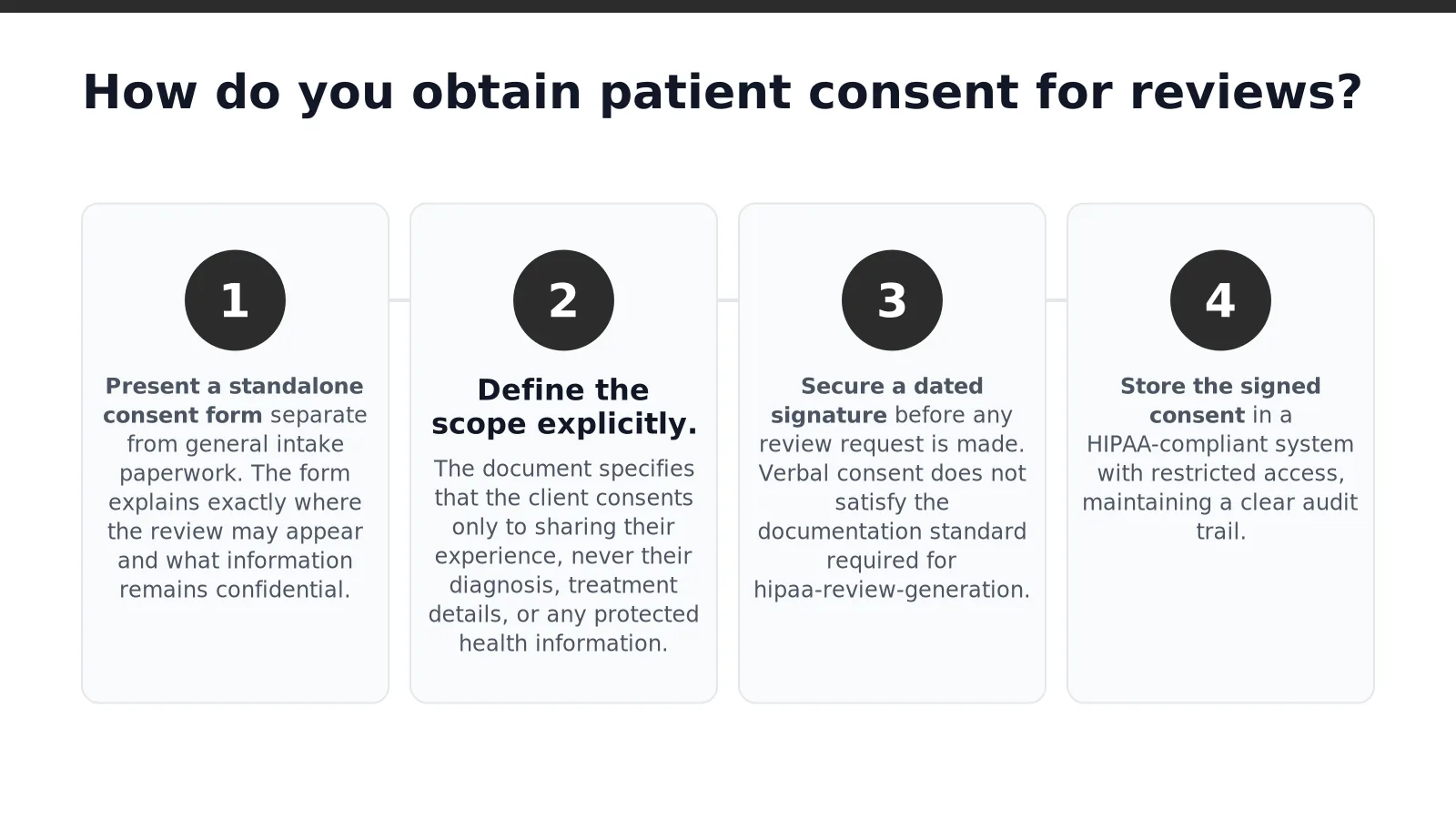
How do you obtain patient consent for reviews?

Obtaining patient-consent-reviews documentation is a non-negotiable prerequisite before any feedback collection begins. Skipping this step exposes a practice to ethical violations and potential HIPAA breaches that compromise both client trust and professional standing.

The consent process follows a structured sequence. Mental Marketing specializes in providing ethical and compliant marketing solutions tailored exclusively for mental health professionals:

  1. Present a standalone consent form separate from general intake paperwork. The form explains exactly where the review may appear and what information remains confidential.

  2. Define the scope explicitly. The document specifies that the client consents only to sharing their experience, never their diagnosis, treatment details, or any protected health information.

  3. Secure a dated signature before any review request is made. Verbal consent does not satisfy the documentation standard required for hipaa-review-generation.

  4. Store the signed consent in a HIPAA-compliant system with restricted access, maintaining a clear audit trail.

What should a review consent form include?

A compliant consent form names the specific platforms where feedback may be published. It confirms the client understands their participation is voluntary and revocable. The form also reiterates that treatment quality never depends on providing a review.

Can a client withdraw consent after posting?

Yes. A client retains the right to revoke consent at any time. Our team maintains a documented process for immediate review removal upon receiving a written withdrawal request. This safeguard protects the therapeutic relationship and upholds the ethical standards central to ethical-reviews-therapy.

We maintain confidentiality throughout the entire review process. Review-request-templates we deploy never reference clinical outcomes or session content. All feedback collection and storage occurs exclusively on secure, encrypted platforms. This approach ensures practices collect authentic social proof without exposing any protected health information, keeping every testimonial fully compliant with both HIPAA and professional ethics codes.

What should a review request template include?

A review request template must secure documented patient consent before any information leaves the practice. The template also needs built-in confidentiality safeguards and a clear path to a secure feedback platform. Without these three elements, a practice risks both ethical violations and HIPAA breaches that can trigger formal complaints, reputational damage, and loss of licensure.

How do we obtain valid consent for a review request?

We obtain patient-consent-reviews authorization through a standalone, signed document that explains exactly where the feedback will appear and what details the client authorizes us to share. The consent form must confirm the client understands the request is voluntary and that declining will not affect their care. We never bundle this consent inside general intake paperwork where it might be overlooked.

What confidentiality language belongs in the template?

The template must state explicitly that the client controls what information becomes public. We instruct clients to describe their experience in general terms without disclosing diagnosis, session content, or treatment specifics. This approach maintains confidentiality throughout the review process while still allowing authentic feedback. Our ethical-reviews-therapy framework treats every review as protected health information until the client explicitly releases it.

How do we structure the actual request?

A compliant template follows this sequence:

  1. State the voluntary nature of the request in plain language at the top.

  2. Specify the platform where the review will appear and confirm the client's comfort with that visibility.

  3. Provide sample language that avoids clinical details while capturing the therapeutic relationship.

  4. Include a direct link to a HIPAA-compliant feedback collection tool.

  5. Close with a reminder that the client may revoke consent at any time.

We use secure platforms to collect and store feedback because standard review sites lack the encryption mental health practices require. Hipaa-review-generation demands that every step, from the initial ask to the final published comment, occurs inside a protected environment. Review-request-templates that skip this step expose practices to data breach liability.

Mental Marketing Pros embeds these safeguards into every template we develop. Our HIPAA-compliant review strategies ensure that practices grow their online presence without compromising the trust clients place in them.

Which platforms are safe for collecting reviews?

Safe review collection platforms meet two non-negotiable criteria. The platform must support HIPAA-compliant data handling and provide secure contact methods that protect client confidentiality. Without both safeguards, a practice exposes itself to compliance violations and reputational damage that no marketing gain can offset.

Mental health practices face stricter platform requirements than most businesses. A standard review site lacks the encryption, access controls, and consent workflows that psychotherapy records demand. Mental Marketing Pros evaluates every platform against these standards before recommending it for hipaa-review-generation workflows.

What makes a review platform HIPAA-compliant for therapy practices?

A compliant platform provides end-to-end encryption, a signed Business Associate Agreement, and granular permission settings. These features prevent unauthorized access to any information that could identify a current or former client. The platform must also support patient-consent-reviews documentation, storing proof that the individual gave informed permission before any feedback was published.

How do secure platforms support ethical review collection?

Secure platforms enable ethical-reviews-therapy by embedding consent capture directly into the feedback flow. We configure review-request-templates that include clear disclosure language, opt-out mechanisms, and links to the practice's Notice of Privacy Practices. This approach maintains confidentiality throughout the review process while using secure platforms to collect and store feedback.

Platform evaluation criteria for mental health practices:

  • Business Associate Agreement availability and scope

  • Encryption standards for data in transit and at rest

  • Consent management and audit trail capabilities

  • Integration with existing practice management systems

  • Review moderation controls that prevent PHI exposure

Mental Marketing identifies Google Business Profile, schema markup, and reviews as the three core local ranking signals for therapists. The platform choice directly affects two of those three signals. A poorly chosen platform undermines local visibility and creates compliance risk simultaneously.

We emphasize designing accessible and welcoming digital spaces with secure contact methods. The review platform becomes an extension of that digital space. Every interaction a prospective client has with the practice's online presence must reinforce trust, not erode it through insecure data practices or ethically questionable solicitation methods.

How do you respond to reviews without violating HIPAA?

Responding to client reviews demands strict adherence to HIPAA's privacy framework. A single acknowledgment of the therapeutic relationship can constitute a disclosure. The safest response template acknowledges feedback without confirming any clinical connection.

We follow a structured, compliant process for every review response. This process protects client confidentiality while demonstrating professional engagement. Our approach aligns with the ethical codes of the APA and ACA. Mental Marketing Pros upholds in every client interaction.

What can you safely say in a public review response?

The answer is less than most practitioners assume. We never confirm that a reviewer is or was a client. We avoid mentioning appointment details, treatment progress, or any clinical context. A generic expression of gratitude for feedback remains the safest path. Phrases like "We appreciate you sharing your experience" acknowledge the reviewer without validating a provider-patient relationship.

How do you handle negative reviews while staying compliant?

Negative reviews create heightened risk for defensive disclosures. We respond with the same neutral, non-confirmatory language used for positive feedback. We offer a general invitation to contact the practice through secure channels. This approach maintains patient-consent-reviews boundaries without escalating public disputes. Our team drafts responses that protect the practice from accidental PHI exposure.

Ethical-reviews-therapy practices require us to maintain confidentiality throughout the entire review lifecycle. We obtain informed consent before any client shares information publicly. We use only secure, HIPAA-compliant platforms for collecting and storing feedback. Our hipaa-review-generation methods never expose personal health details in any public forum.

What template works for most review responses?

We recommend a simple, repeatable structure. First, thank the reviewer without naming them. Second, avoid any language that confirms treatment. Third, provide a generic practice contact path.

  1. Open with "We appreciate your feedback" or a similar neutral phrase.

  2. Never use the reviewer's name or reference their specific comments.

  3. Include a general statement about the practice's commitment to care.

  4. Offer a secure, private channel for further discussion if needed.

These review-request-templates keep responses safe and professional. We train our partner practices to use this framework consistently. A disciplined response protocol eliminates the risk of an inadvertent HIPAA violation.

What are common HIPAA review mistakes to avoid?

The most damaging HIPAA review mistakes expose protected health information or solicit testimonials from vulnerable clients. A single breach affects a patient's employment, insurance eligibility, child custody proceedings, and personal relationships in ways a compromised routine medical record typically does not. The 2026 Guide to HIPAA Compliance for Mental Health Practices documents these cascading consequences.

Hipaa-review-generation requires collecting feedback without exposing personal health details. To remain compliant, we collect reviews without exposing protected health information. This principle governs every review strategy we implement for therapy practices.

What happens when a review reveals too much?

A client writes a glowing review that mentions their diagnosis, treatment frequency, or specific therapeutic modality. That review now functions as a public disclosure of protected health information. The practice bears responsibility for that exposure, even when the client authored the content voluntarily.

How do we prevent ethical violations in review collection?

Ethical-reviews-therapy demands proactive safeguards rather than reactive cleanup. We follow these steps:

  1. Screen every review request against current client status and vulnerability factors.

  2. Use review-request-templates that never reference treatment details or session specifics.

  3. Obtain documented patient-consent-reviews before publishing any client-authored content.

  4. Monitor published reviews for inadvertent PHI disclosure and address findings immediately.

Mental Marketing Pros implements HIPAA-compliant strategies designed for sustained, long-term growth. Our approach upholds the highest levels of care and confidentiality while helping practices stand out in a competitive marketplace.

How can a marketing partner ensure compliant growth?

A marketing partner ensures compliant growth by embedding HIPAA and ethics-code alignment into every client acquisition strategy. Mental Marketing Pros delivers HIPAA-compliant digital marketing built exclusively for mental health professionals. Without this specialized foundation, practices risk regulatory penalties and reputational damage that erode patient trust permanently.

Our approach integrates three non-negotiable safeguards into every campaign.

  1. Ethics-code alignment across all channels. We map every marketing tactic to the APA Ethics Code 5.05 prohibition on soliciting testimonials from vulnerable clients and the ACA Code A.3.b restrictions. This means our ethical-reviews-therapy framework never pressures current patients. Instead, we design compliant feedback loops that respect the therapeutic relationship while building your online reputation.

  1. Secure data handling from first click to intake. Our HIPAA-compliant digital marketing infrastructure encrypts all patient information across websites, forms, and ad platforms. A single unsecured contact form exposes your entire practice to breach liability.

  1. Structured growth through the Wellness Booking Blueprint. This proprietary system helps practices multiply bookings and grow their client base 2 to 5 times. The blueprint sequences patient-consent-reviews protocols, review-request-templates, and hipaa-review-generation workflows into a repeatable system. Each step documents consent before any public-facing feedback appears.

What safeguards prevent unethical review solicitation?

We never ask current therapy clients for testimonials. Our templates target former clients and professional colleagues only. Every review-request-templates deployment includes explicit opt-in language and revocation instructions. This protects both the patient and the practice from board complaints.

How does compliance accelerate rather than slow growth?

Compliance removes the single largest threat to a mental health practice: loss of licensure. Practices operating without hipaa-review-generation safeguards face fines and ethics investigations. Our framework turns regulatory adherence into a competitive advantage. Referral sources and directory platforms increasingly prioritize verified compliant practices, which means ethical positioning directly feeds your pipeline.

FAQ

What makes a review HIPAA-compliant?

A HIPAA-compliant review protects the client's identity and health information at every stage, never exposing that an individual received mental health services or disclosing any treatment details.

Conclusion

A compliant review strategy protects your practice from regulatory penalties and preserves the therapeutic relationship. Implementing documented consent protocols, secure feedback channels, and disciplined response templates transforms a potential liability into a sustainable growth asset. The decision to embed these safeguards now determines whether your online reputation builds trust or invites board scrutiny.