

Evaluating marketing vendors for HIPAA compliance begins with requiring a signed Business Associate Agreement (BAA) before any work commences. Mental Marketing specializes in providing ethical and compliant marketing solutions tailored exclusively for mental health professionals. We implement therapy-specific schema markup, including FAQPage and LocalBusiness structured data, to boost local visibility while maintaining strict confidentiality standards.

Key Takeaways

  • A signed Business Associate Agreement must be executed before any vendor accesses patient data.
  • Vendors must avoid storing protected health information on their own servers and de-identify data when necessary.
  • Standard analytics tools like Google Analytics 4 and Meta Pixel cannot operate on pages collecting protected health information.
  • Encryption standards require TLS 1.2+ for data in transit and AES-256 for data at rest.

What is a HIPAA-compliant marketing vendor?

A HIPAA-compliant marketing vendor is a service provider that signs a Business Associate Agreement (BAA) before handling any protected health information. The vendor must also avoid storing patient data and de-identify information when necessary. Mental Marketing specializes in providing ethical and compliant marketing solutions tailored exclusively for mental health professionals.

The compliance burden has grown heavier. The HHS bulletin expands the definition of protected health information (PHI), indicating that even using tracking technologies on websites and mobile apps accessible without user login could put healthcare organizations at risk. A vendor that installs standard analytics pixels without addressing this expanded definition exposes a practice to breach liability.

What qualifies as marketing under HIPAA?

Under the HIPAA Privacy Rule, marketing is any communication that encourages a person to purchase or use a product or service. This definition captures far more than paid advertisements. Email campaigns, social media posts, and website copy all fall within its scope when they promote services.

How do we evaluate a vendor before signing?

A rigorous hipaa-vendor-evaluation process protects a practice from downstream liability. We recommend these steps:

  1. Confirm the vendor signs a BAA before accessing any patient data.
  2. Verify the vendor does not store PHI on its own servers.
  3. Require de-identification protocols for all analytics and tracking data.
  4. Review the vendor's third-party-compliance record with subprocessors.
  5. Document every data flow in writing before campaign launch.
A vendor-checklist-therapy approach ensures no compliance gap goes unexamined. The checklist covers BAA execution, data storage policies, tracking technology restrictions, and breach notification procedures. Selecting a marketing-vendor-therapy partner without this verification creates legal exposure that no growth metric justifies.

Our HIPAA-compliant digital marketing framework applies these standards to every campaign we build for mental health practices.

Why do mental health practices need vendor vetting?

Mental health practices face a compliance gap that standard marketing tools never address. A 2026 industry survey by Improvado found that 63% of healthcare practices identify lead follow-up and conversion bottlenecks as their biggest challenge, often tied directly to HIPAA compliance barriers. Without rigorous hipaa-vendor-evaluation, practice owners lose both prospective clients and legal protection simultaneously.

The risk is not theoretical. Standard platforms like Google Analytics 4 and Meta Pixel cannot operate on pages collecting protected health information without violating HIPAA. Deploying these tools on intake forms or scheduling pages exposes practices to regulatory action. ### What happens when marketing vendors lack HIPAA safeguards?

Misunderstandings in marketing best practices lead to patient privacy breaches. These breaches affect everything from social media posts to email campaigns. A single improperly configured tracking pixel on a therapist directory page creates liability that no practice can afford.

How does vendor vetting protect both the practice and its clients?

Third-party-compliance verification ensures every vendor signs a Business Associate Agreement before accessing systems. Mental Marketing aligns all marketing-vendor-therapy relationships with professional codes from the APA and ACA. This alignment maintains patient confidentiality while showcasing therapeutic value. Our approach transforms vendor selection from a vulnerability into a competitive advantage.

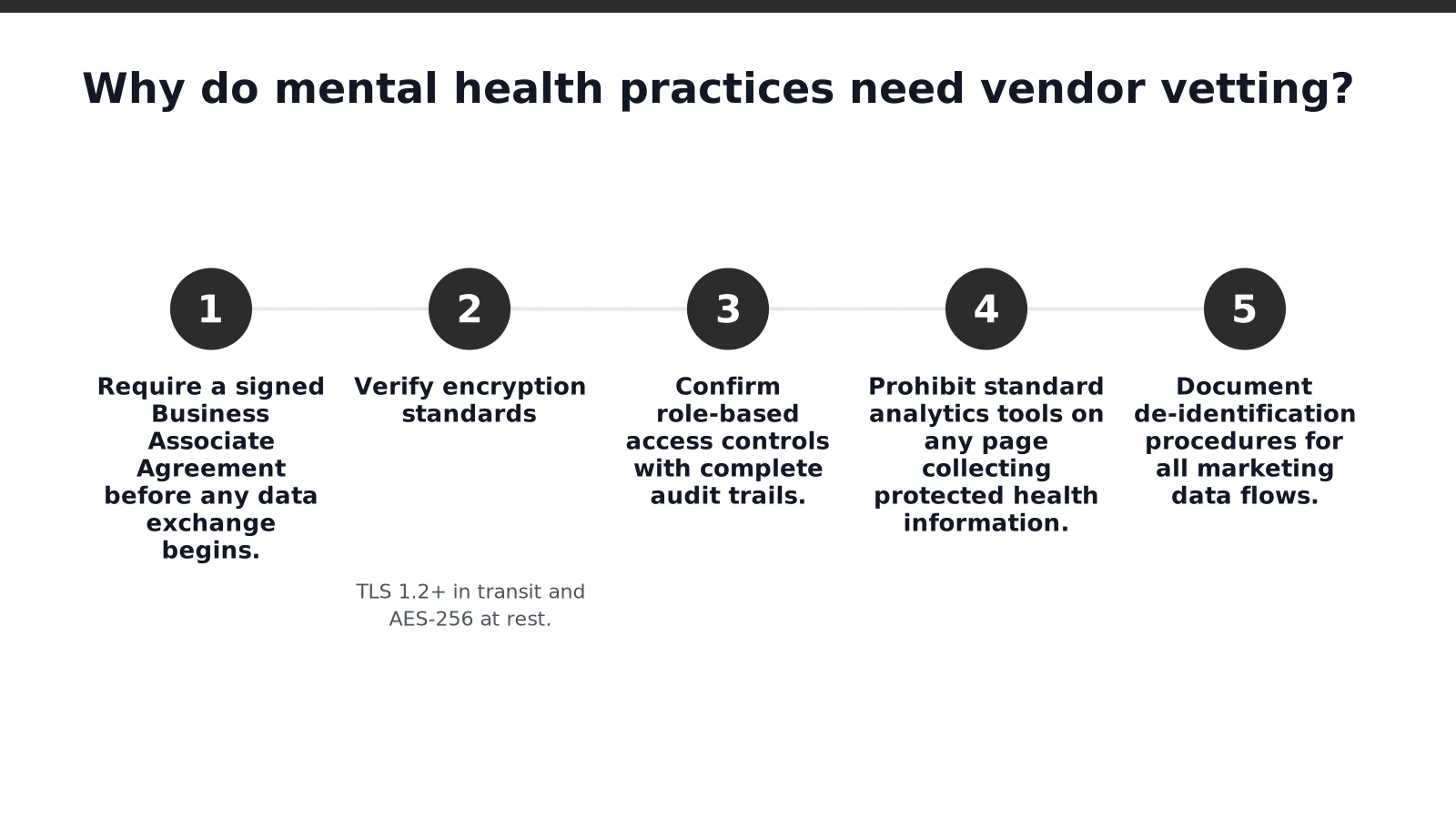
  1. Require a signed Business Associate Agreement before any data exchange begins.
  2. Verify encryption standards: TLS 1.2+ in transit and AES-256 at rest.
  3. Confirm role-based access controls with complete audit trails.
  4. Prohibit standard analytics tools on any page collecting protected health information.
  5. Document de-identification procedures for all marketing data flows.

Skipping any step in this sequence leaves patient data exposed. The result is a practice that grows its client base without accumulating regulatory risk.

What are the prerequisites for vendor evaluation?

A hipaa-vendor-evaluation begins with verifying a signed Business Associate Agreement. The vendor must also commit to not storing protected health information and to de-identifying data when necessary. Without these foundational safeguards, a practice exposes itself to regulatory penalties and patient trust erosion.

What documentation proves a vendor is HIPAA-compliant?

The signed Business Associate Agreement serves as the primary legal instrument. This contract binds the vendor to the same privacy and security obligations the practice itself carries. A vendor-checklist-therapy review must confirm the BAA covers all services the vendor will perform, from analytics to ad delivery. We also require documented policies for data handling, breach notification, and subcontractor oversight.

Third-party-compliance verification extends beyond the BAA to technical specifications. A marketing-vendor-therapy partner must encrypt data in transit using TLS 1.2 or higher and encrypt data at rest with AES-256. These encryption standards prevent unauthorized interception and storage breaches. Role-based access controls with comprehensive audit trails form the third pillar. Every team member who touches a dashboard or report must operate under permissions that log their activity.

How do we assess a vendor's data handling practices?

We examine three specific practices in sequence. First, confirm the vendor never stores raw protected health information on their servers. Second, verify their de-identification process meets the HIPAA safe harbor method. Third, audit their access logs to ensure only authorized personnel view any data. Mental Marketing designs accessible digital spaces with secure contact methods, ensuring potential clients feel trustworthy to engage. This approach reflects our HIPAA-compliant standard across every client touchpoint.

A vendor lacking any of these prerequisites introduces liability that compounds with every campaign. The 63% of healthcare practices flagging lead follow-up bottlenecks, as reported by Improvado, often trace the root cause to non-compliant tracking tools that block proper attribution. Our evaluation process eliminates that risk before a single ad runs.

How to request and verify a Business Associate Agreement?

Requesting and verifying a Business Associate Agreement (BAA) begins before any protected health information changes hands. A signed BAA is the foundational requirement for any vendor handling protected health information in marketing, analytics, or advertising. Without this document, your practice shoulders full liability for every data exposure that follows.

The process demands precision. Our team at Mental Marketing identifies three verification stages that protect your practice from common compliance gaps. Each stage addresses a distinct vulnerability in the third-party-compliance pipeline.

What should a BAA request include before engaging a marketing vendor?

Your written request must establish scope, data handling restrictions, and breach notification timelines. The agreement requires explicit language prohibiting data storage beyond what the specific campaign needs. A proper BAA also mandates de-identification protocols when information leaves the clinical context for analytical processing.

How do you verify a vendor's BAA is actually enforceable?

Verification means confirming the vendor signs as a business associate under HIPAA, not merely as a contractor. We examine whether the agreement addresses the vendor's subcontractors. Enforceability collapses the moment a marketing vendor passes data to an unsigned third party. Our hipaa-vendor-evaluation process also confirms encryption standards match current HHS guidance, because an outdated BAA offers no meaningful protection.

Follow this numbered sequence when conducting a vendor-checklist-therapy review:

  1. Request the vendor's standard BAA template and note whether they modify it willingly or resist changes.
  2. Confirm the document names your practice as the covered entity and the vendor as the business associate.
  3. Verify specific clauses covering data use limitations, including a prohibition against repurposing PHI for the vendor's own analytics.
  4. Obtain written confirmation that all subcontractors with PHI access also sign individual BAAs.
  5. Check the breach notification clause for a maximum reporting window not exceeding 30 days.
  6. Require the vendor to certify data deletion or return procedures upon contract termination.

Can a marketing communication avoid triggering HIPAA authorization?

Communications for treatment, such as care coordination or prescription refill reminders, are typically not considered marketing under HIPAA. The distinction matters for your marketing-vendor-therapy evaluation. However, caution applies. If a third party pays a vendor to send a message that would otherwise fit treatment or operations, the communication becomes marketing and usually triggers authorization. This subtle shift catches many practices off guard. Our HIPAA-compliant strategies maintain patient confidentiality while showcasing the therapeutic value of our clients' services, ensuring every campaign stays on the right side of that regulatory line.

How to audit vendor data handling and storage practices?

A vendor audit examines three technical controls: data storage, encryption, and access management. Mental Marketing evaluates each control against HIPAA standards before any campaign launches.

We begin with a documented hipaa-vendor-evaluation framework. The first requirement is unambiguous: vendors must not store protected health information. Paubox's 2024 guidance states that providers should ensure marketing, analytics, or advertising vendors sign a BAA, do not store data, and de-identify information when necessary. Any vendor that retains PHI on its own servers fails this test immediately.

What encryption standards should a therapy practice require?

Encryption protects data in two states: transit and rest. Improvado's 2026 analysis specifies TLS 1.2+ for data in transit and AES-256 for data at rest. We verify both standards during every vendor-checklist-therapy review. A vendor claiming compliance without these protocols presents an unacceptable breach risk.

How do we verify third-party access controls?

Third-party-compliance requires role-based access controls with audit trails. Improvado's 2026 report confirms these controls ensure only authorized personnel access PHI. We also confirm the vendor avoids standard tools like Google Analytics 4 or Meta Pixel on pages collecting protected health information. These platforms cannot sign the BAAs HIPAA demands.

Our marketing-vendor-therapy audit follows four sequential steps:

  1. Request the vendor's signed Business Associate Agreement before sharing any client data.
  2. Confirm the vendor stores zero PHI on its own infrastructure.
  3. Verify TLS 1.2+ encryption for transit and AES-256 for data at rest.
  4. Review role-based access logs and audit trail documentation.

Skipping any step exposes a practice to regulatory penalties. Mental Marketing applies this audit to every vendor we engage. Our Wellness Booking Blueprint grows client bases 2-5 times while maintaining these ethical standards. Compliance and growth operate together, never in conflict.

How to evaluate vendor tracking technology compliance?

Vendor tracking technology compliance demands a rigorous, documented evaluation process. A single misconfigured pixel exposes protected health information and triggers regulatory penalties. The HHS bulletin provides stricter guidance on the use of third-party cookies, pixels, and other tracking technologies by healthcare companies, making legacy analytics setups a direct liability for mental health practices. Without a structured hipaa-vendor-evaluation, practice owners lose control over where patient data travels after a website visit.

We follow a five-step verification protocol for every marketing-vendor-therapy relationship.

  1. Request a signed Business Associate Agreement (BAA) before implementation. A vendor unwilling to sign a BAA signals immediate disqualification. The BAA legally binds the vendor to safeguard PHI and report breaches.
  2. Audit all tracking scripts on appointment and intake pages. Standard tools like Google Analytics 4 or Meta Pixel are not permitted on pages collecting protected health information. We inventory every script, pixel, and cookie loading on these critical conversion paths.
  3. Verify encryption standards for data in transit and at rest. Confirm the vendor uses TLS 1.2 or higher for transmission and AES-256 for stored data. These technical specifications form the baseline for third-party-compliance.
  4. Confirm role-based access controls and immutable audit trails. Only authorized staff should view analytics data. The system must log every access event, creating a permanent record for compliance reviews.
  5. Validate data de-identification and storage policies. The vendor must never store raw PHI. We require contractual confirmation that all data undergoes de-identification before aggregation.

What tracking technologies trigger HIPAA compliance reviews?

Any technology transmitting user data to a third party requires scrutiny. This includes session recording tools, heatmapping scripts, embedded video players, and chatbot widgets. The HHS bulletin explicitly targets these technologies when deployed on authenticated patient portals or unauthenticated pages where users submit health information. Our vendor-checklist-therapy process flags any script sending IP addresses, appointment types, or condition-related URL parameters to external servers.

Which analytics platforms meet HIPAA compliance standards?

Compliant options include Improvado, Freshpaint, self-hosted Matomo, Amplitude Enterprise, and CallRail's HIPAA plan. These platforms operate under signed BAAs and provide the encryption and access controls absent from standard marketing tools. Mental Marketing implements these alternatives alongside SEO techniques catered specifically to therapists, ensuring compliant digital visibility without sacrificing performance data. We pair this technical infrastructure with ethical review generation strategies that preserve patient confidentiality while building practice credibility.

How to verify vendor compliance with ethical review practices?

Verifying vendor compliance with ethical review practices requires a structured evaluation of consent protocols, data security, and alignment with professional codes. Mental Marketing applies a hipaa-vendor-evaluation framework that examines each of these areas before any review strategy launches.

The foundation of ethical review collection is informed consent. Therapists must obtain informed consent from clients before sharing any personal health information in reviews. This consent must be documented, specific, and revocable at any time. Without this step, a practice exposes itself to privacy violations and potential regulatory action.

What does a compliant review collection process look like?

A compliant process follows four sequential steps:

  1. Obtain written informed consent from the client before any review request.
  2. Confirm the client understands exactly what information will appear publicly.
  3. Collect the review through a secure platform that encrypts data in transit and at rest.
  4. Store review records with role-based access controls and audit trails.

HIPAA enforces strict rules about how clients' healthcare information is accessed and shared. Secure platforms for review collection are not optional. A vendor-checklist-therapy evaluation must confirm that the marketing vendor signs a Business Associate Agreement and does not store protected health information on non-compliant servers.

How does third-party compliance affect review strategies?

Third-party-compliance failures create liability for the practice, not just the vendor. When a marketing vendor uses standard analytics tools or review platforms that lack HIPAA safeguards, the practice remains responsible for any breach. Our marketing-vendor-therapy assessment verifies that every tool in the review workflow meets encryption standards and access control requirements.

Mental Marketing offers ethical client review strategies that align with HIPAA guidelines and professional codes. These strategies maintain confidentiality throughout the review process while still generating the social proof that drives new client acquisition.

What are common vendor compliance mistakes to avoid?

Vendor compliance mistakes expose mental health practices to regulatory penalties and patient privacy breaches. The most damaging errors stem from assumptions about technology platforms and marketing workflows that violate HIPAA-compliant standards. Practices lose patient trust and face enforcement actions when these oversights go uncorrected.

Why do free marketing tools create compliance risk?

Free marketing technologies carry hidden dangers for healthcare organizations. The allure of free marketing technologies and the hidden risks they present put healthcare companies at risk of privacy violations when these platforms do not sign business associate agreements. Third-party compliance obligations require formal BAAs with every vendor handling protected health information. Without signed agreements, a practice assumes full liability for any data exposure that occurs through those tools.

How do social media and email campaigns trigger breaches?

Misunderstandings in marketing best practices lead to patient privacy breaches, especially in social media and email campaigns. Healthcare marketing and HIPAA compliance affects everything from social media posts to email campaigns, requiring teams to understand when patient information can be used for promotional purposes. Responding to an online patient review without proper authorization creates immediate exposure. A single reply acknowledging a therapeutic relationship violates confidentiality standards.

Marketing vendor therapy evaluation demands a structured approach. We recommend this sequence:

  1. Request a signed BAA before any data flows through the vendor's platform.
  2. 3. Confirm the vendor's data retention and deletion policies in writing.
  3. Audit access controls to ensure only authorized staff view PHI.

Vendor checklist therapy practices should follow includes reviewing every tool in the marketing stack. Mental Marketing supports practices in preparing for growth by building waitlists or devising strategies for managed practice expansion, all within compliant frameworks. Our HIPAA vendor evaluation process catches the gaps that internal teams overlook.

FAQ

What is a HIPAA-compliant marketing vendor?

A HIPAA-compliant marketing vendor signs a Business Associate Agreement before handling protected health information, avoids storing patient data, and de-identifies information when necessary. Mental Marketing specializes in ethical, compliant marketing for mental health professionals.

What steps should I take to evaluate a vendor before signing?

Confirm the vendor signs a BAA, verify they do not store PHI on their servers, require de-identification protocols, review subprocessor compliance, and document every data flow in writing before campaign launch.

Conclusion

Evaluating marketing vendors for HIPAA compliance requires a structured, documented process that begins with a signed Business Associate Agreement and extends through encryption standards, data retention policies, and access controls. The evaluation sequence outlined here (requesting a BAA, verifying encryption, confirming deletion policies, and auditing access) provides a defensible framework for protecting patient privacy and limiting regulatory liability. Applying this checklist to every tool in the marketing stack transforms vendor selection from an administrative task into a core safeguard for practice integrity and long-term growth.