
Clinic reputation management combines HIPAA-compliant review monitoring with ethical client-testimonial strategies. Over 70% of patients choose providers based on reviews. We guide mental health practices through confidential collection methods, sentiment tracking across platforms, and compliant response protocols, protecting patient privacy while strengthening online trust and visibility for sustained practice growth.

Key Takeaways for HIPAA-Compliant Clinic Reputation Management

  • Over 70% of patients choose healthcare providers based on online reviews and ratings.
  • HIPAA-compliant review monitoring protects patient privacy while building clinic credibility and trust.
  • Systematic patient feedback collection transforms satisfied patients into advocates for your practice.
  • Online reputation directly impacts new patient acquisition and long-term practice growth metrics.
Mental Marketing specialist reviewing HIPAA-compliant online reputation management dashboard for a mental health clinic.

What Is Clinic Reputation Management?

Clinic reputation management covers three ongoing tasks: monitoring what patients say, responding to that feedback, and generating new reviews across the platforms where patients choose a provider, including Google and Healthgrades. For a mental health practice, these three functions work together as a system rather than isolated chores. Neglecting any one piece leaves gaps that competitors, or dissatisfied former clients, can fill first.

Mental health practices face a sharper set of stakes than most medical specialties. Understanding HIPAA guidelines becomes essential before any practice solicits or manages client reviews. A single careless response can expose a treatment relationship the client never agreed to disclose. We treat this as the foundation of Clinic Reputation Management, not an afterthought bolted onto marketing. The regulations that govern review collection exist for a clear reason: they protect client privacy and keep every collection method ethical, from the first ask to the final published response.

Why does reputation management matter more for therapy practices than other clinics?

Therapy carries a confidentiality burden that orthopedics or dermatology rarely faces. A positive review that names a diagnosis or describes a session detail can breach trust and violate regulation simultaneously. Reputation management for behavioral health practices has to account for this layered risk at every step.

What counts as a reputation touchpoint beyond reviews?

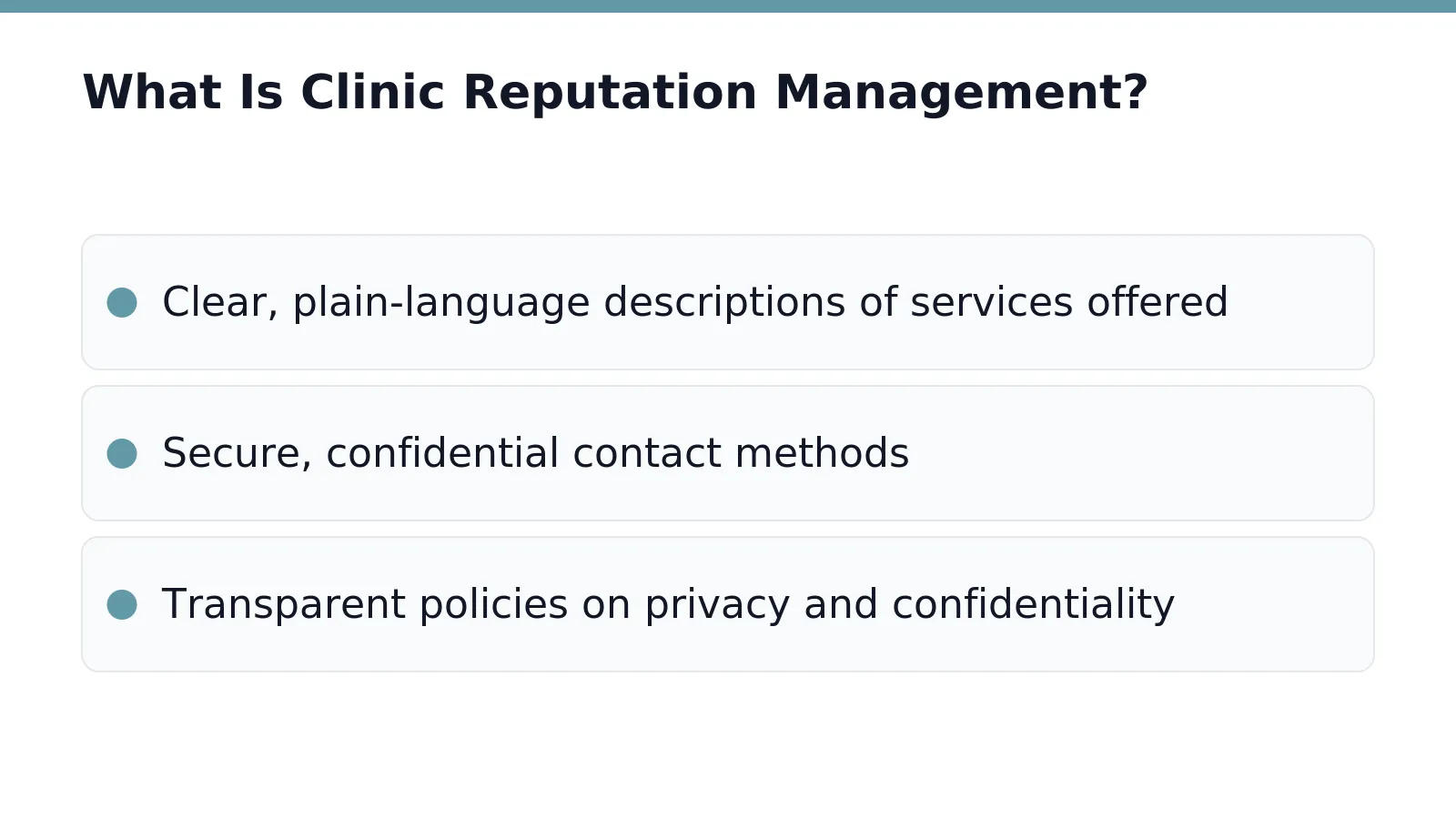
Reputation extends past star ratings into a clinic's own digital spaces. Intake pages and contact forms function as the initial point of contact for prospective clients and must be designed to build trust and support conversion. A well-built intake page shapes first impressions:

  • Clear, plain-language descriptions of services offered
  • Secure, confidential contact methods
  • Transparent policies on privacy and confidentiality

Mental Marketing specialist reviewing HIPAA-compliant online reputation management for a mental health clinic.

Why Do HIPAA Rules Govern Review Monitoring?

HIPAA governs review monitoring because federal privacy law restricts how clinics access, store, and share clients' protected health information. Mental health practices carry higher stakes than most medical fields: a single disclosed diagnosis or treatment detail in a public review can expose a client's confidential relationship with a practice. We treat this risk as the starting point for any Clinic Reputation Management strategy, not an afterthought added once reviews start arriving.

Before a clinic requests or displays a single testimonial, three safeguards must be in place. We secure informed consent from each client before any personal health information enters a public channel. We maintain confidentiality throughout the entire review process, from the initial request through the published response. We also rely on secure, auditable platforms to collect and store feedback rather than generic consumer apps built for retail reviews.

What Counts As HIPAA-Compliant Review Monitoring?

HIPAA-Compliant Review Monitoring means tracking client feedback across platforms without exposing protected health information at any stage of collection, storage, or response. Clinics need patient review monitoring systems and HIPAA review response protocols built specifically for confidentiality standards, not repurposed marketing dashboards designed for other industries.

What Should Comprehensive HIPAA Review Guidance Include?

Comprehensive guidance for mental health practices covers three areas: the core HIPAA requirements clinics must follow, best practices for collecting ethical and compliant testimonials, and the marketing value compliant reviews generate once gathered responsibly. Strong healthcare reputation management connects all three. Skipping any one of these areas leaves gaps that put client trust, and practice liability, at serious risk.

How Does Multi-Platform Patient Review Monitoring Work?

Dedicated monitoring systems pull patient feedback from every major review site into a single dashboard. We rely on tools built for this purpose, automating review requests, filtering flagged negative feedback for clinical review, and generating reports that give leadership clear oversight. Patient review monitoring replaces the old method of checking each platform by hand. Staff no longer log into five separate sites to see what patients are saying.

Clinic Reputation Management depends on this consolidated view because sentiment shifts quickly across platforms, and a single missed comment can affect a referral decision made the same day. We treat multi-platform tracking as a baseline operational function, not an optional add-on. A clinic that monitors only one site operates with a partial picture of its public reputation.

What makes review monitoring tools different from consumer apps?

Generic consumer apps were never built to handle protected health information. Legitimate healthcare reputation management platforms are different: they remain HIPAA-compliant by design and connect directly with electronic medical record systems used in clinical settings. That integration matters for mental health practices. Even acknowledging a review requires careful HIPAA review response protocols to avoid confirming a patient relationship.

How often should clinics review their monitoring data?

We build HIPAA-Compliant Review Monitoring into regular growth audits rather than treating it as a quarterly afterthought. Sustained practice growth depends on tracking review volume and sentiment trends over time, not reacting to isolated comments. These audits function alongside other growth metrics:

  • Review volume by platform, tracked monthly
  • Sentiment trends across reporting periods
  • Response times for flagged or negative feedback
  • Dashboard summaries shared with clinic leadership

Treated this way, monitoring becomes a steady operational habit, feeding every other growth decision the practice makes.

What Are HIPAA Review Response Protocols?

HIPAA review response protocols set the rules for how a mental health practice replies to patient feedback without exposing protected health information. A compliant reply never confirms that the reviewer received care at our practice. We acknowledge the feedback in general terms and invite the person to continue the conversation offline, through a phone call or secure message.

This restraint is not optional courtesy. Healthcare reputation management rests on HIPAA's strict control over who can access and disclose a client's health information. Confirming a treatment relationship in a public reply, even to thank someone, can constitute a disclosure violation. The safest response treats every comment as though it came from someone whose care status is unconfirmed.

Does ignoring negative reviews protect our practice?

No. Clinics that respond to every review, including the critical ones, build more trust than clinics that only showcase five-star praise. Silence on negative feedback reads as avoidance to prospective clients. HIPAA-compliant review monitoring means tracking all incoming feedback and applying the same generic, confidentiality-first language regardless of tone.

The obligations behind response protocols mirror the obligations behind collecting testimonials in the first place. Our teams must secure informed consent before any personal health information moves into a review process, maintain confidentiality at every step, and rely on secure platforms for storage. Response protocols extend that same discipline to the public-facing side of the conversation.

A sound patient review monitoring and response framework for practice leaders includes:

  • Monitoring every platform where clients may post feedback
  • Applying a standard, pre-approved reply template that avoids confirming care
  • Routing sensitive complaints to a private, secure channel
  • Training front-desk and clinical staff on consistent response language

Dedicated compliance guidance exists specifically to walk practices through these core HIPAA requirements, covering collection, response, and the marketing value of handling both correctly. Strong clinic reputation management depends on treating response protocols as seriously as the reviews themselves.

How Can Practices Solicit Reviews Ethically?

Ethical review solicitation begins at intake, not after a crisis in star ratings. We treat the intake and landing page experience as the first touchpoint for setting expectations about onboarding and feedback. Clients who understand, from their very first interaction, that we may invite them to share their experience later encounter no surprises and no pressure.

Booking tools built into that onboarding process give practices a natural channel for requesting feedback. When appointment scheduling and mobile-responsive design are already part of the client journey, a feedback request fits in as a logical next step rather than an intrusion. We never bolt solicitation onto a process that wasn't designed for it; we build it in from the start.

When Should a Practice Request a Review?

Timing shapes response rates more than most practices realize. Providers who send a text-based review request immediately following a visit generate three to five times the reviews compared with those who wait days or weeks, according to findings cited in a complete guide to review and reputation management for primary care clinics. We recommend treating the window right after a completed session as the highest-value moment for outreach.

Every solicitation method we use upholds the same privacy protections that govern the rest of the client relationship. That means:

  • No direct mention of diagnosis, treatment type, or clinical details in any request
  • Secure, consent-based contact methods rather than public tagging or unsolicited outreach
  • Clear opt-out language in every message
  • Review requests framed around experience, never clinical outcome

Clinic reputation management succeeds only when solicitation respects confidentiality as rigorously as every other part of care.

Why Do Reviews Shape Patient Decisions?

Reviews function as a trust shortcut for prospective clients who cannot evaluate clinical skill before their first appointment. More than seven in ten patients now choose a provider based on reviews rather than relying solely on word-of-mouth referrals, according to reporting on healthcare reputation management software. That shift matters enormously for mental health clinics. Sensitive concerns make trust the deciding factor long before a phone call ever happens.

The numbers climb higher the closer we look at decision-stage behavior. Over 81% of potential patients weigh online reviews before choosing a healthcare provider, per coverage of patient feedback platforms. We see this pattern as evidence that clinic reputation management has moved from optional branding exercise to a core access point for new client inquiries. Clinics without a visible, current review presence risk being screened out before a prospective client ever reads the clinic's website copy.

Do most patients research providers online before making contact?

Yes. Seventy-seven percent of patients use online reviews as their first step when selecting a new healthcare provider, based on a Software Advice patient review survey cited in 2026 healthcare reputation management reporting. This first step happens well before intake forms or consultation calls, which means patient review monitoring shapes outcomes earlier in the client journey than most practice owners assume.

What happens after a patient reads a positive review?

Trust built through reviews carries forward into the booking experience itself. A conversion-focused onboarding process reinforces the credibility reviews establish, turning initial interest into a completed appointment. Strong reviews alone rarely convert; the clinic's intake experience has to match the trust those reviews created. Prospective clients disengage before booking.

How Do Reviews Boost AI and Local Search Visibility?

Two structured data types drive local search visibility for a clinic: FAQPage schema for common patient questions and LocalBusiness schema for location data. We treat these as the foundation of Clinic Reputation Management. Search engines need machine-readable signals before they can surface a practice prominently. Reviews alone rarely carry that weight; they work alongside structured markup.

We apply Schema.org vocabulary across a clinic's website, layering in name, address, and phone details alongside service areas and review markup. This combination strengthens how a practice appears in local search results across the United States. Search engines read these signals far more reliably than plain text, which means a well-marked-up page earns visibility that an unstructured one simply cannot.

What does FAQPage schema actually encode?

FAQPage schema marks up frequently asked questions in a format search engines parse directly. LocalBusiness schema, by contrast, encodes name, address, phone number, service types, and location details. Together, they give search engines a complete, structured profile of the clinic rather than scattered mentions buried in paragraphs.

Why do rich snippets matter for a mental health practice?

Rich snippets give prospective clients a quick, trustworthy preview before they click through. When FAQ and LocalBusiness structured data pair with an active review profile, search engines generate clearer, more informative snippets. This clarity supports patient review monitoring efforts. Accurate structured data and genuine feedback reinforce one another rather than compete for attention.

For practice owners weighing where to invest first, the priority order looks like this:

  1. Implement LocalBusiness schema with accurate NAP data
  2. Add FAQPage schema addressing real patient questions
  3. Layer in review markup to support healthcare reputation management across local search

What Trust Signals Matter Most for Clinics?

Three signals determine whether a mental health clinic appears trustworthy online: a complete Google Business Profile, structured schema markup, and a strong review history. We identify these as the core local ranking factors that shape visibility for therapy practices searching for new clients. Clinics that neglect any one of these pillars risk losing ground to competitors who have built out all three.

Clinic Reputation Management depends heavily on review quality, not just quantity. A single glowing review can distinguish one practice from dozens of similar listings in a crowded local market. For clinics competing in saturated metro areas, that kind of digital word of mouth often carries more weight than paid advertising.

Trust does not end at the review section, though. The first digital touchpoint, whether a landing page or an intake form, signals credibility just as strongly as star ratings do. Clinics must design these entry points carefully, since prospective clients judge professionalism within seconds of arrival.

Why do reputation tools matter for patient trust?

Reputation monitoring platforms exist specifically to help clinics earn the confidence needed to attract new patients. They consolidate scattered feedback into a single, manageable view. For mental health clinic executives, this matters because trust, once lost publicly, is difficult to rebuild quietly.

What should executives prioritize first?

Executives should audit three areas before expanding marketing spend:

  • Google Business Profile accuracy and completeness
  • Schema markup implementation across the website
  • Consistency and responsiveness in the clinic's review profile

Strengthening these foundations builds the trust layer that patient review monitoring and HIPAA-compliant review monitoring efforts are designed to protect.

FAQ

Why does HIPAA matter for mental health clinic reviews?

A single review disclosing a diagnosis or session detail breaches patient confidentiality and violates federal privacy law. Mental Marketing treats HIPAA safeguards as the foundation of reputation management, not an afterthought.

What tasks make up clinic reputation management?

It combines monitoring patient feedback, responding to it, and generating new reviews across platforms like Google and Healthgrades. These three functions work as one system, since neglecting any piece leaves gaps competitors can fill.

Besides reviews, what else shapes a clinic's reputation?

Intake pages and contact forms serve as the first touchpoint for prospective clients and must build trust. They need plain-language service descriptions, secure contact methods, and transparent privacy policies.

Conclusion

In closing, clinic reputation management represents a unified system where review monitoring, structured data implementation, and trustworthy patient touchpoints reinforce one another to establish credibility in local search results. Mental health practices that prioritize Google Business Profile accuracy, schema markup, and responsive review engagement build the foundational trust layer that converts prospective clients into booked appointments. The integration of these three pillars, not reputation management in isolation, determines whether a clinic attracts sustained client growth or loses visibility to competitors who have invested in comprehensive digital credibility.