Marketing data handling for mental health clinics requires HIPAA-compliant systems that protect patient confidentiality while enabling strategic growth. Our agency implements secure intake landing pages with encrypted forms and therapy schema markup, ensuring every digital touchpoint meets regulatory standards. Mental Marketing Pros builds these safeguards into every campaign layer. We prioritize ethical data practices that build trust and support sustainable practice expansion.
- HIPAA enforces strict rules about how clients' healthcare information is accessed and shared.
- A single misstep in marketing-data-therapy workflows exposes protected health information and triggers regulatory penalties.
- Protected health information includes names, email addresses, phone numbers, and IP addresses when linked to mental health services.
- Secure data workflows for lead forms encrypt every submission from capture to storage using HIPAA-compliant infrastructure.
What are the core privacy risks in marketing data handling?
Mental health marketing carries privacy risks that generic industries never face. A single misstep in marketing-data-therapy workflows exposes protected health information and triggers regulatory penalties.
The stakes are high. Patients navigating mental health challenges often need immediate, accessible, and empathetic care. When marketing systems mishandle their data, those patients lose trust in the entire therapeutic relationship before the first session begins.
What makes mental health marketing data uniquely sensitive?
Mental health records reveal diagnoses, treatment histories, and deeply personal vulnerabilities. Unlike retail purchase data, this information carries stigma and discrimination risk. Data-privacy-therapy failures therefore cause harm that extends far beyond regulatory fines.
The present and future of mental health is digital. From telehealth counseling to mobile apps, more people seek support through technology than ever before. Each digital touchpoint creates data that marketing teams must protect. This heightened sensitivity demands that every marketing workflow treat client information with the same rigor as clinical records, ensuring that no data point is ever exposed without explicit, documented authorization.
How do we identify and mitigate these risks?
We follow a structured assessment process for every campaign:
- Inventory all data collection points. Document every form, tracking pixel, and analytics tool that touches client information.
- Classify data by sensitivity level. Separate protected health information from general website analytics.
- Audit third-party integrations. Verify that every vendor meets HIPAA-compliant standards before deployment.
- Implement secure-data-workflows for campaign execution. Restrict access to authorized team members only.
- Review consent mechanisms. Confirm that every patient-data-marketing activity has explicit, documented permission.
Our HIPAA-compliant digital marketing framework addresses these risks systematically. We treat privacy as a foundational requirement, not an afterthought.
What happens when privacy protections fail?
A breach erodes patient confidence permanently. Prospective clients abandon intake forms. Existing patients question whether their disclosures remain confidential. The practice loses both revenue and reputation in a single incident.
Mental Marketing Pros builds privacy safeguards into every campaign layer. We protect the therapeutic alliance by protecting the data that surrounds it. Regulatory penalties compound the damage, making compliance a financial imperative as well as an ethical one.
How does HIPAA govern patient data in marketing workflows?
These regulations directly shape every marketing workflow that touches protected health information. Without compliant processes, practices risk regulatory penalties and erosion of client trust. Our approach embeds these requirements into every campaign we build.
What constitutes protected health information in a marketing context?
Protected health information includes any data that could identify a client alongside their treatment status. This category encompasses names, email addresses, phone numbers, and IP addresses when linked to mental health services. We treat every data point in a marketing workflow as potentially regulated. This conservative stance prevents inadvertent disclosures before they occur.
How does consent shape compliant marketing workflows?
We obtain informed consent from clients before sharing any personal health information. This requirement applies to testimonials, case studies, and review collection. Consent documentation must specify exactly what information is shared and for what purpose. Our secure-data-workflows ensure this authorization is recorded and auditable. We never repurpose client data for marketing without explicit, documented permission.
Marketing-data-therapy strategies demand rigorous data-privacy-therapy protocols. We maintain confidentiality throughout every client touchpoint. Review collection platforms must never expose personal health details. Our patient-data-marketing systems use encrypted, HIPAA-compliant channels for all client communications. Mental Marketing Pros aligns these workflows with professional codes from the APA and ACA. Every campaign undergoes compliance review before launch. The result is marketing that grows your practice without compromising the trust clients place in your care.
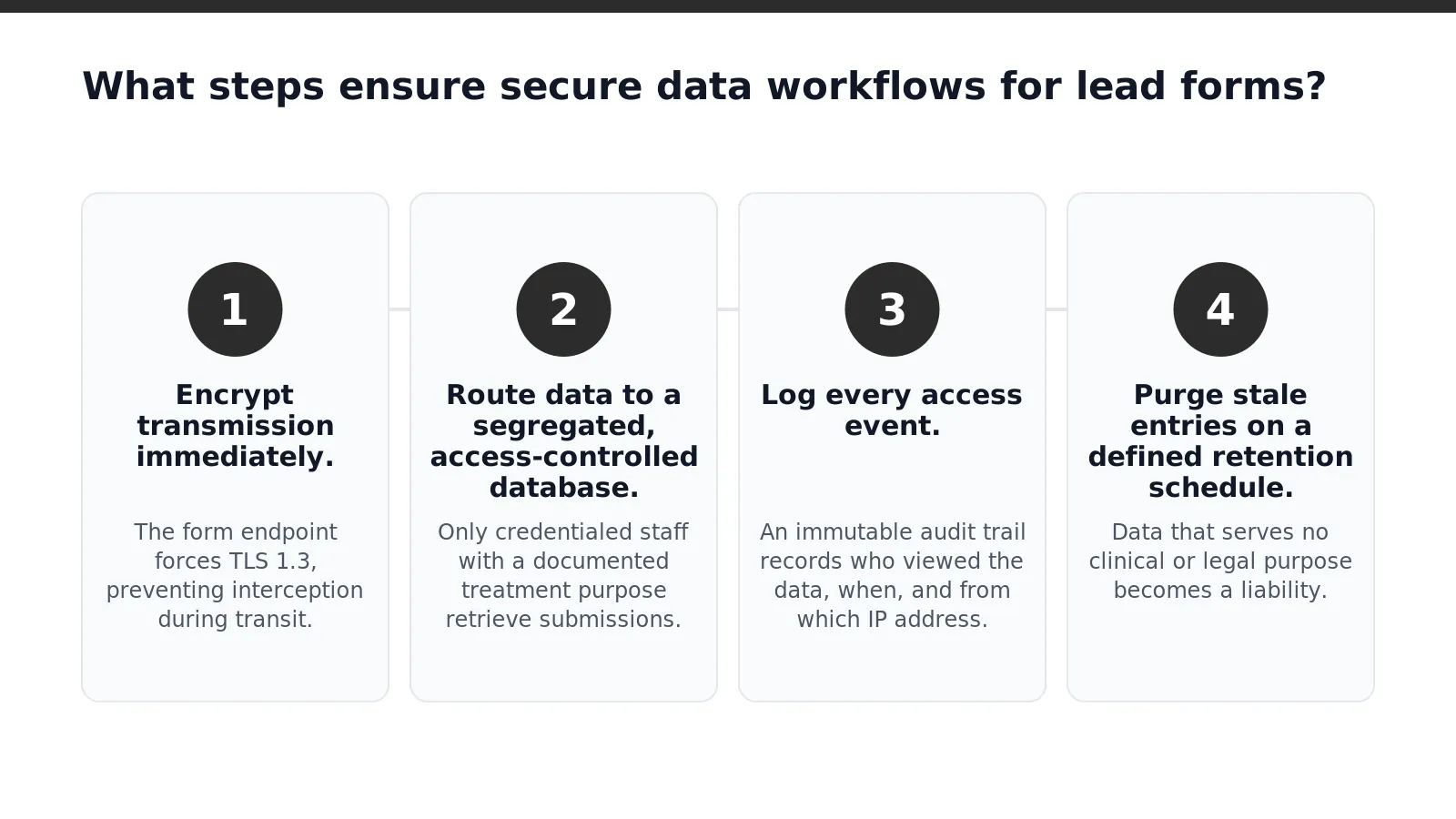
What steps ensure secure data workflows for lead forms?
Secure data workflows for lead forms begin with a HIPAA-compliant infrastructure that encrypts every submission from capture to storage. Without this foundation, practices expose sensitive patient information to breaches that destroy trust and trigger regulatory penalties. Effective therapist intake landing pages are essential for mental health practices seeking to improve client onboarding and increase lead generation. Mental Marketing Pros builds these workflows to protect both the practice and the prospective client at every touchpoint.
How do we configure the intake form itself?
We strip the form down to essential fields only. Each unnecessary data point multiplies compliance risk. Optimized client onboarding includes appointment booking integrations and mobile-responsive design for seamless user access. Our therapist intake landing page templates embed these principles directly into the form architecture, ensuring the collection layer never asks for more than the clinical team needs to schedule that first session.
What happens after the client submits the form?
- Encrypt transmission immediately. The form endpoint forces TLS 1.3, preventing interception during transit.
- Route data to a segregated, access-controlled database. Only credentialed staff with a documented treatment purpose retrieve submissions.
- Log every access event. An immutable audit trail records who viewed the data, when, and from which IP address.
- Purge stale entries on a defined retention schedule. Data that serves no clinical or legal purpose becomes a liability.
These secure-data-workflows eliminate the gap between submission and storage where most exposures occur. We also apply the same rigor to feedback collection. Practices must use secure platforms to collect and store feedback, a principle that extends directly to intake data. Patient-data-marketing strategies fail the moment a single form submission sits unprotected in an unencrypted inbox.
Can we integrate appointment booking without breaking compliance?
Yes, when the booking engine operates inside the same encrypted environment as the form. The integration passes a tokenized identifier rather than raw protected health information. This approach preserves the seamless experience that converts visitors into scheduled clients while keeping data-privacy-therapy standards intact. Marketing-data-therapy workflows that bypass this step create a compliance gap that no consent form can close.
How can tracking pixels be used without violating privacy?
Tracking pixels collect behavioral data without storing protected health information. We implement these tools through anonymized, consent-based configurations that never capture session recordings, form field entries, or any individually identifiable patient details.
What makes a tracking pixel HIPAA-compliant?
A tracking pixel becomes compliant when it transmits only de-identified aggregate metrics. We strip all personal identifiers before data leaves the browser. The pixel records page views, traffic sources, and conversion events without linking that activity to a specific individual. Our approach ensures every tracking mechanism operates within a Business Associate Agreement framework where required.
How do we configure pixels to protect patient identity?
- Disable automatic form field tracking and session replay features in the pixel settings.
- Configure the tag management system to fire pixels only on non-authenticated pages.
- Implement server-side data processing that strips IP addresses and browser fingerprints before transmission.
- Add a consent management platform that blocks all tracking scripts until the visitor explicitly opts in.
These four steps create secure-data-workflows that prevent accidental disclosure. The configuration blocks pixels on appointment booking pages, intake forms, and client portals. We maintain full analytics visibility on public-facing content while walling off any page where protected health information might appear.
Can pixels coexist with therapy website schema markup?
Yes. Schema markup, combined with FAQ and LocalBusiness structured data, strengthens local visibility for therapist websites by clarifying content for search engines through rich snippets. Pixels measure how visitors interact with those rich results. The two technologies serve complementary functions. Schema tells search engines what the page contains. Pixels tell us whether the page attracts the right audience. Neither technology requires personal data to function effectively.
Our patient-data-marketing framework treats every data point as a potential liability until proven otherwise. We design accessible and welcoming digital spaces with secure contact methods that build trust before the first click. The pixel strategy reflects that same philosophy. It gathers marketing-data-therapy insights without crossing the line into clinical territory. Practices lose nothing by restricting pixel access to public pages. They gain actionable traffic intelligence while eliminating the compliance risk that unconfigured tracking creates.
Our ethical, HIPAA-compliant growth strategies extend to every technical implementation detail. Data-privacy-therapy requirements demand this level of precision. A single misconfigured pixel exposes a practice to regulatory penalties and erodes the trust that makes therapy possible.
What is the role of CRM automation in patient data marketing?
CRM automation transforms patient-data-marketing from a manual, error-prone process into a secure, scalable system for client acquisition and retention. Mental Marketing's approach involves strategic client acquisition and retention marketing, where automated workflows handle intake, follow-up, and re-engagement without exposing protected health information. Without automation, practices lose prospective clients during the gap between first contact and human response. That delay costs practices revenue and sends potential clients to competitors who engage faster.
How does CRM automation support data-privacy-therapy compliance?
Automation enforces data-privacy-therapy protocols at every touchpoint. Our systems apply role-based access controls so only authorized staff view sensitive records. Automated audit trails log every access event, creating a verifiable compliance record. These secure-data-workflows encrypt data in transit and at rest, meeting the encryption standards required under HIPAA. The result is a marketing engine that never compromises confidentiality for speed.
What steps build a compliant marketing-data-therapy automation sequence?
Follow this numbered procedure to implement marketing-data-therapy automation without regulatory risk.
- Map every data touchpoint from first website visit to session booking, identifying where protected health information enters the system.
- Select a CRM platform with a signed Business Associate Agreement (BAA), confirming the vendor accepts legal liability for data handling.
- Configure field-level encryption for intake forms, ensuring names, contact details, and clinical notes remain unreadable outside authorized sessions.
- Build automated triggers for appointment reminders and post-session follow-ups that reference only generic service descriptions, never diagnosis codes.
- Test the full sequence with dummy records before any live patient data enters the workflow.
How does automation multiply bookings while protecting patient data?
Our Wellness Booking Blueprint helps practices multiply their bookings, growing their client base 2-5 times within a short period. Automation drives this growth by instantly confirming appointments, reducing no-shows through timed reminders, and reactivating dormant leads with privacy-safe re-engagement campaigns. Each automated message maintains confidentiality throughout the review process, using secure platforms to collect and store feedback without exposing identities. The system scales client volume while shrinking the administrative burden on clinical staff.
How do you audit your practice for data privacy compliance?
A data privacy audit examines every touchpoint where patient-data-marketing intersects with protected health information. Mental Marketing Pros conducts these audits to identify vulnerabilities before they trigger regulatory penalties or erode client trust. The process maps how information flows from intake forms to follow-up communications.
We begin with a systematic review of all digital assets. This includes your website, scheduling tools, email systems, and any third-party platforms handling client details. Each tool must meet HIPAA-compliant standards for encryption and access controls. A single unsecured endpoint compromises the entire practice.
What are the first steps in a privacy audit?
We inventory every data collection point across your marketing infrastructure. Contact forms, newsletter signups, and appointment request pages all require scrutiny. The audit then verifies that each vendor provides a business associate agreement where required.
How do we integrate compliance with growth strategies?
Effective lead generation relies on SEO best practices, content marketing, and regular client growth audits. We align these activities with secure-data-workflows that protect client information at every stage. Mental Marketing Pros supports mental health clinics in preparing for growth by building waitlists or devising strategies for managed practice expansion. This dual focus ensures compliance never becomes a bottleneck to scaling your practice.
Our audit framework follows a numbered sequence:
- Map all marketing-data-therapy collection points across your website and third-party tools.
- Verify encryption standards for data in transit and at rest on every platform.
- Review access permissions and authentication protocols for staff and contractors.
- Document vendor compliance and confirm active business associate agreements.
- Test data deletion and retention policies against current regulatory requirements.
Data-privacy-therapy considerations extend beyond technical safeguards. We examine how client testimonials are gathered and displayed. We review the language on landing pages to confirm it sets accurate expectations about confidentiality. These strategies are designed not just for immediate visibility but for sustained, long-term growth. A compliant practice builds lasting trust. That trust converts visitors into clients who feel safe from the first click.
What common mistakes compromise patient data in marketing?
Mental health practices compromise patient data most often through unprotected review collection and promotional strategies that prioritize visibility over guidance. The urgency to regulate and protect patients is greater than ever, as noted by Precise Behavioral's October 2025 analysis of mental health data privacy trends. Without secure-data-workflows, practices expose protected health information through routine marketing activities that appear harmless on the surface.
How do review requests accidentally expose patient information?
Public review platforms create immediate risk when practices solicit testimonials without data-privacy-therapy safeguards. We see clinics lose control of protected health information through three common failures:
- Asking clients to post reviews on public platforms where they may inadvertently disclose treatment details
- Failing to implement a private feedback collection system before publishing any client comments
- Neglecting to obtain explicit, HIPAA-compliant consent that specifies exactly what information may be shared
You must collect reviews without exposing protected health information. This requirement shapes every step of our patient-data-marketing protocols at Mental Marketing Pros.
What makes promotional content a privacy liability?
Content that promotes services without guiding and reassuring potential clients creates dual exposure. Healthcare marketers must ensure their strategies guide, inform, and reassure rather than simply broadcast availability. When marketing-data-therapy campaigns lack educational framing, they attract inquiries through unsecured channels. Prospective clients often share sensitive details in contact forms or initial calls before any HIPAA-compliant infrastructure protects that information.
Our HIPAA-compliant framework addresses this by embedding privacy checkpoints into every client acquisition pathway. Secure intake forms, encrypted communication portals, and staff training on data handling prevent the casual disclosures that compromise both patient trust and regulatory standing.
How do you build a privacy-first marketing plan for growth?
A privacy-first marketing plan starts with HIPAA-compliant infrastructure and ends with measurable client acquisition. Mental Marketing Pros builds these plans by embedding compliance into every channel, from local search to paid advertising. Without this foundation, practices lose prospective clients who sense friction or distrust in the intake process. The cost is not theoretical. It shows up as abandoned contact forms and silent phone lines.
What compliance standards anchor a privacy-first strategy?
Our framework treats patient-data-marketing as a clinical extension, not an afterthought. Every landing page, call-tracking number, and form submission must route through encrypted, business-associate-governed systems. Multi-location behavioral health clinics need clear guidance on leveraging AI while maintaining trust and regulatory compliance, as noted by Beacon Media + Marketing's 2025 analysis. We configure secure-data-workflows that segment clinical inquiries from marketing analytics, ensuring no protected health information leaks into ad platforms or dashboards.
How do you align growth tactics with ethical data handling?
We design marketing-data-therapy campaigns that never retarget based on sensitive conditions or browsing behavior. Our comprehensive services include SEO and GEO, local search engine optimization, and HIPAA compliant digital marketing. These channels attract high-intent searchers without surveillance-based personalization. Data-privacy-therapy principles guide every keyword cluster and ad group we build.
Follow these steps to launch a compliant growth engine:
- Audit your current digital footprint for unencrypted forms and third-party tracking pixels.
- Deploy a HIPAA-compliant website with schema markup that clarifies your services to search engines.
- Build local SEO assets around condition-specific, non-identifying content clusters.
- Launch Google Ads using only encrypted landing pages and privacy-safe conversion tracking.
- Implement an ethical review strategy that never solicits protected health information.
We cater to various needs whether a practice is insurance-based or self-pay, offering tailor-made marketing plans. Our get started resources walk clinic owners through a client growth audit that identifies compliance gaps before they trigger a breach notification. Growth without privacy is a liability. Growth with privacy is a durable competitive advantage.
What makes mental health marketing data more sensitive than other industries?
Mental health marketing data is more sensitive because it reveals diagnoses, treatment histories, and deeply personal vulnerabilities that carry stigma and discrimination risk. Unlike retail purchase data, exposure of this information can cause harm that extends far beyond regulatory fines, making compliance a clinical necessity.
What are the core privacy risks in marketing data handling for mental health clinics?
HIPAA enforces strict rules about how clients' healthcare information is accessed and shared. The core risks include unauthorized access through unencrypted forms, improper third-party data sharing, and inadvertent disclosure through review collection or tracking pixels.
What happens when privacy protections fail in mental health marketing?
A breach erodes patient confidence permanently. Prospective clients abandon intake forms and existing patients question whether their disclosures remain confidential.
A privacy-first marketing plan transforms compliance from a regulatory burden into a durable competitive advantage. Every encrypted form, privacy-safe ad campaign, and ethical review strategy builds the trust that converts visitors into long-term clients. The decision to embed data protection into every client acquisition pathway determines whether a practice grows securely or exposes itself to irreversible reputational damage.