

Key Takeaways
- A signed Business Associate Agreement must be executed before any vendor accesses patient data.
- Vendors must avoid storing protected health information on their own servers and de-identify data when necessary.
- Standard analytics tools like Google Analytics 4 and Meta Pixel cannot operate on pages collecting protected health information.
- Encryption standards require TLS 1.2+ for data in transit and AES-256 for data at rest.
What is a HIPAA-compliant marketing vendor?
What qualifies as marketing under HIPAA?
How do we evaluate a vendor before signing?
- Confirm the vendor signs a BAA before accessing any patient data.
- Verify the vendor does not store PHI on its own servers.
- Require de-identification protocols for all analytics and tracking data.
- Review the vendor's third-party-compliance record with subprocessors.
- Document every data flow in writing before campaign launch.
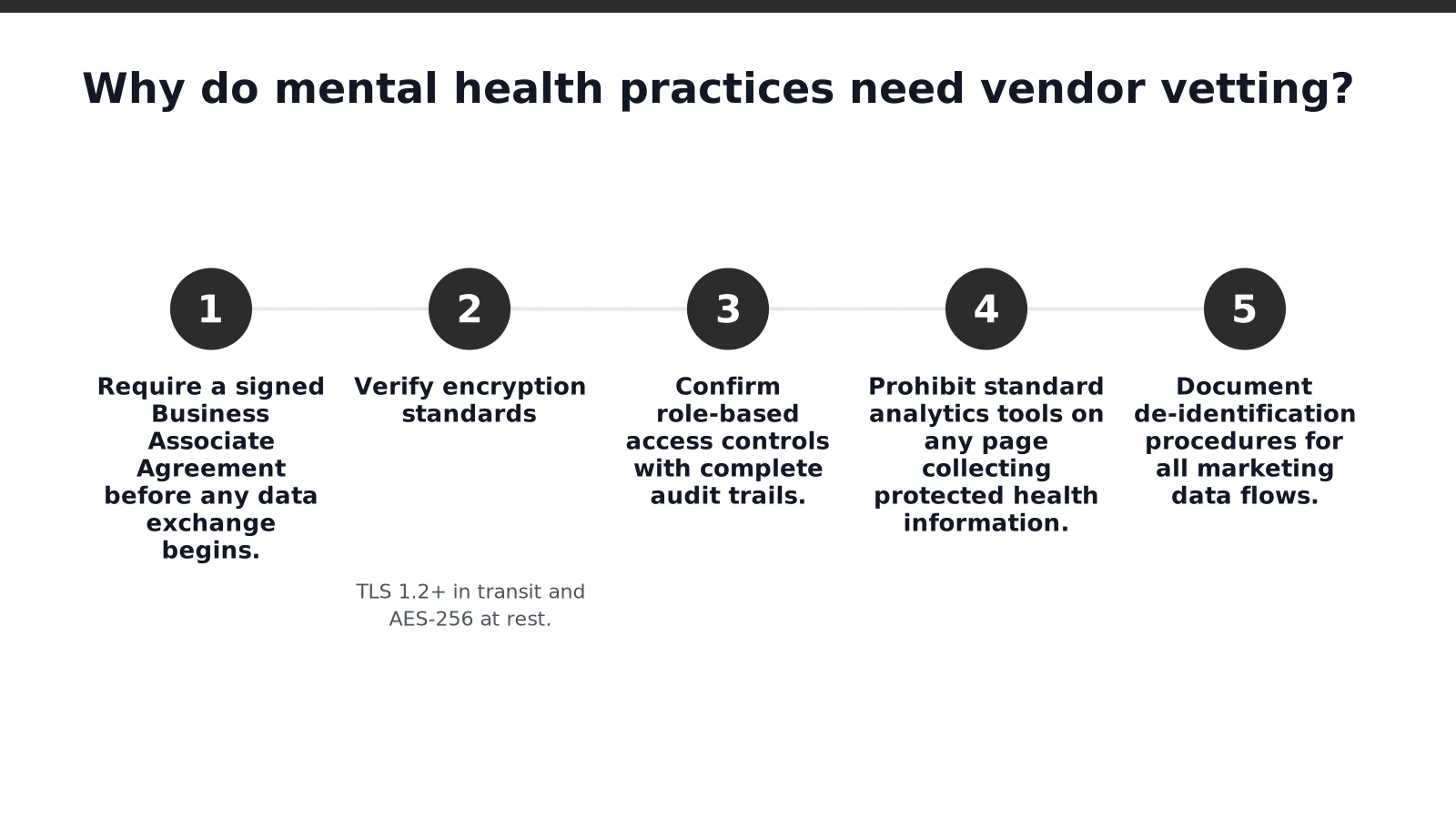
Why do mental health practices need vendor vetting?
How does vendor vetting protect both the practice and its clients?
- Require a signed Business Associate Agreement before any data exchange begins.
- Verify encryption standards: TLS 1.2+ in transit and AES-256 at rest.
- Confirm role-based access controls with complete audit trails.
- Prohibit standard analytics tools on any page collecting protected health information.
- Document de-identification procedures for all marketing data flows.

What are the prerequisites for vendor evaluation?
What documentation proves a vendor is HIPAA-compliant?
How do we assess a vendor's data handling practices?
How to request and verify a Business Associate Agreement?
What should a BAA request include before engaging a marketing vendor?
How do you verify a vendor's BAA is actually enforceable?
- Request the vendor's standard BAA template and note whether they modify it willingly or resist changes.
- Confirm the document names your practice as the covered entity and the vendor as the business associate.
- Verify specific clauses covering data use limitations, including a prohibition against repurposing PHI for the vendor's own analytics.
- Obtain written confirmation that all subcontractors with PHI access also sign individual BAAs.
- Check the breach notification clause for a maximum reporting window not exceeding 30 days.
- Require the vendor to certify data deletion or return procedures upon contract termination.
Can a marketing communication avoid triggering HIPAA authorization?
How to audit vendor data handling and storage practices?
What encryption standards should a therapy practice require?
How do we verify third-party access controls?
- Request the vendor's signed Business Associate Agreement before sharing any client data.
- Confirm the vendor stores zero PHI on its own infrastructure.
- Verify TLS 1.2+ encryption for transit and AES-256 for data at rest.
- Review role-based access logs and audit trail documentation.
How to evaluate vendor tracking technology compliance?
- Request a signed Business Associate Agreement (BAA) before implementation. A vendor unwilling to sign a BAA signals immediate disqualification. The BAA legally binds the vendor to safeguard PHI and report breaches.
- Audit all tracking scripts on appointment and intake pages. Standard tools like Google Analytics 4 or Meta Pixel are not permitted on pages collecting protected health information. We inventory every script, pixel, and cookie loading on these critical conversion paths.
- Verify encryption standards for data in transit and at rest. Confirm the vendor uses TLS 1.2 or higher for transmission and AES-256 for stored data. These technical specifications form the baseline for third-party-compliance.
- Confirm role-based access controls and immutable audit trails. Only authorized staff should view analytics data. The system must log every access event, creating a permanent record for compliance reviews.
- Validate data de-identification and storage policies. The vendor must never store raw PHI. We require contractual confirmation that all data undergoes de-identification before aggregation.
What tracking technologies trigger HIPAA compliance reviews?
Which analytics platforms meet HIPAA compliance standards?
How to verify vendor compliance with ethical review practices?
What does a compliant review collection process look like?
- Obtain written informed consent from the client before any review request.
- Confirm the client understands exactly what information will appear publicly.
- Collect the review through a secure platform that encrypts data in transit and at rest.
- Store review records with role-based access controls and audit trails.
How does third-party compliance affect review strategies?
What are common vendor compliance mistakes to avoid?
Why do free marketing tools create compliance risk?
How do social media and email campaigns trigger breaches?
- Request a signed BAA before any data flows through the vendor's platform.
- 3. Confirm the vendor's data retention and deletion policies in writing.
- Audit access controls to ensure only authorized staff view PHI.