
Compliant Facebook ad strategies help mental health practices reach a platform used by over 3 billion people while meeting Meta's Advertising Standards and HIPAA requirements. We build campaigns targeting prospective clients without exposing protected health information, pairing ad copy review with policy-aligned creative so practices grow bookings safely and sustainably.

Key Takeaways for Compliant Therapist Facebook Ads

  • Facebook reaches over 3 billion users, making it essential for therapy practices seeking new clients.

  • Mental Marketing helps therapists master Facebook advertising to boost profits and practice lifestyle simultaneously.

  • Facebook's Advertising Standards review each ad against specific policies before placement goes live.

  • Therapists overcome advertising hesitation by understanding that Facebook mastery isn't as difficult as perceived.

What Are Therapist Facebook Ad Services?

Therapist Facebook Ad Services combine ad strategy, compliance review, and campaign management built specifically for mental health practices advertising on Facebook. Over 3 billion people use the platform, giving practice owners a reach few other channels can match. We build campaigns that put this scale to work for clinics seeking new clients, not generic retail traffic.

Facebook's advertising platform does something general marketing cannot: it places messages in front of users actively researching therapy options. The platform's targeting tools identify people exploring mental health topics, then surfaces ads for relevant services at the right moment. That precision matters more for clinical care than for most consumer products.

Why do mental health practices need specialized ad management instead of generic social media marketing?

Generic marketers rarely understand clinical advertising restrictions, patient privacy expectations, or the trust barriers prospective clients face before booking. Mental Marketing Pros, based in the United States, builds campaign structures around these realities rather than treating therapy like any other local service.

Our approach to Facebook advertising for therapists typically includes:

  • Campaign setup aligned with platform advertising policies for health-related content

  • Audience targeting calibrated to local service areas and client demographics

  • Creative review to avoid stigmatizing or non-compliant messaging

  • Ongoing performance monitoring and budget adjustment

Is Facebook worth the investment for a small practice?

Scale alone answers this. With billions of active users, even a modest, well-targeted budget reaches a meaningful slice of the local population researching therapy. Practices that skip paid social lose visibility to competitors already occupying that space.

Mental Marketing Pros specialist reviewing HIPAA-compliant Facebook ads for a therapy practice.

What Does Meta Ad Compliance Require For Therapists?

Compliance demands two layers of scrutiny working together. The first layer is federal law: HIPAA-compliant practices must secure informed consent before sharing any personal health information, protect confidentiality at every step, and rely on secure platforms for client-facing material. HIPAA enforces strict boundaries on how clients' healthcare information gets accessed and shared. That standard does not pause at the edge of an ad campaign. Mental health marketing content falls under the same rules as clinical records.

The second layer sits on top of federal law: Meta's own Advertising Standards. These standards spell out, in granular detail, which ad content is permitted and which gets rejected outright. We treat Meta ad compliance for mental health campaigns as a dual obligation, not a single checkbox. A practice can satisfy HIPAA fully and still see an ad rejected for violating platform policy, so both layers require independent attention.

How Does Meta Review Therapy Ads Before They Run?

Every ad submitted to the platform gets reviewed individually against current policy at the moment it is placed. Nothing goes live automatically. This per-ad review means a single campaign can contain both approved and rejected creative simultaneously, depending on wording and imagery choices.

What Happens If A Therapy Practice's Ad Gets Rejected?
Rejection does not end the process. Practices that believe an ad was mistakenly denied. That a business account was wrongly restricted, can request a formal review through Meta's Account Quality tools. We build this appeal step into every ad launch workflow, treating it as part of the campaign process rather than an exception.

Building toward Therapist Facebook Ad Services means designing creative that clears platform review on the first submission, protecting both account standing and campaign momentum.

HIPAA-compliant digital marketing dashboard and therapy client acquisition strategy for mental health practices.

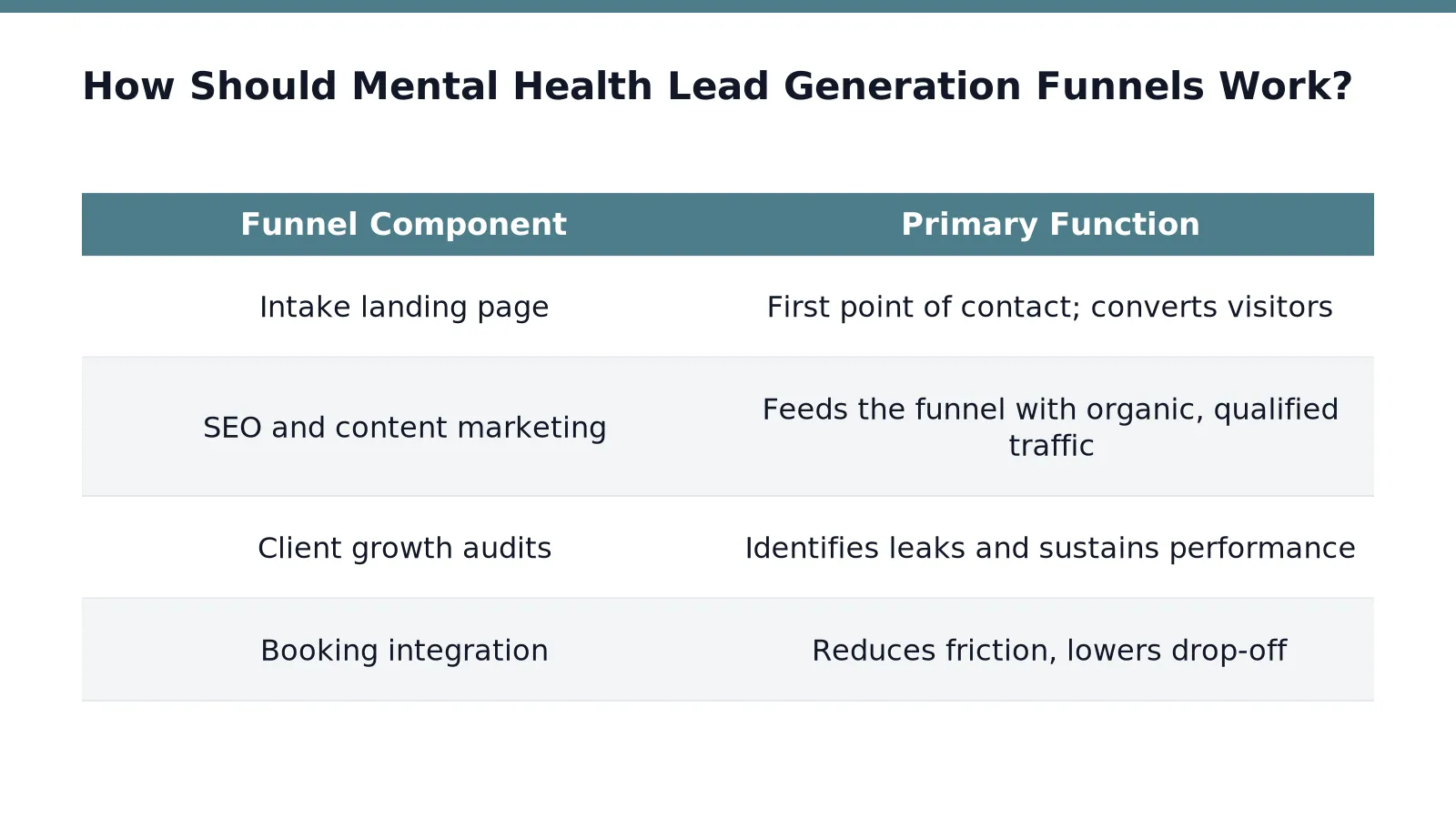
How Should Mental Health Lead Generation Funnels Work?

Strong mental health lead generation funnels start with the intake landing page, not the ad itself. That page serves as the first point of contact for prospective clients. It must be built to optimize onboarding and conversion. A funnel that ignores this step loses prospects before a single appointment request is ever submitted.

Paid traffic from Facebook advertising for therapists only pays off when the destination page matches the effort behind the click. Sustained lead generation depends on three pillars working together: SEO best practices, content marketing, and regular client growth audits that feed the funnel with qualified traffic. Skip any one pillar, and the funnel stalls regardless of ad spend.

What makes an intake page convert?

Appointment booking integrations and mobile-responsive design form the backbone of effective onboarding. These features keep drop-off low by letting prospective clients schedule a session without friction, regardless of device. We treat both as non-negotiable requirements, not optional upgrades.

Why does the landing page matter more than the ad?

Ads generate clicks; landing pages generate clients. Every intake page must prioritize user experience and conversion to strengthen onboarding outcomes from paid traffic. Mental health practice owners who evaluate therapy practice CAC benchmarks often find that weak landing pages, not weak ad targeting, drive acquisition costs upward.

Funnel Component

Primary Function

Intake landing page

First point of contact; converts visitors

SEO and content marketing

Feeds the funnel with organic, qualified traffic

Client growth audits

Identifies leaks and sustains performance

Booking integration

Reduces friction, lowers drop-off

Each layer depends on the one before it. A funnel missing any component underperforms, no matter how well the ad campaign itself is built.

Mental Marketing Pros specialist reviewing HIPAA-compliant Facebook ad strategies for therapy practices in Orlando.

What Are Realistic CAC Benchmarks For Therapy Practices?

Realistic client acquisition cost benchmarks for therapy practices depend on how much weight a practice places on paid channels versus organic visibility. We treat Google Business Profile optimization, schema markup, and review generation as the three core local ranking signals that reduce dependence on paid spend over time. Practices leaning heavily on advertising alone tend to carry a higher acquisition cost per client than those building organic authority alongside any ad campaigns.

Structured data plays a direct role in that cost equation. FAQ schema and LocalBusiness schema clarify practice information for search engines, which strengthens local visibility through rich snippets. That improved visibility lowers therapy practice CAC benchmarks gradually. Fewer prospective clients need to come from paid clicks when organic search already surfaces the practice.

Does Facebook advertising raise or lower acquisition costs for therapists?

Facebook advertising for therapists can inflate acquisition costs early on. Practices new to paid advertising often encounter a long, confusing setup process, and that complexity translates into wasted ad spend before campaigns start performing. We view this setup friction as a hidden cost that rarely appears in advertised CAC figures but shows up in actual billing.

What keeps acquisition costs sustainable long-term?

Sustainable acquisition costs come from combining paid and organic channels rather than relying on either alone. Practices that pair Facebook campaigns with strong local search signals typically see acquisition costs stabilize faster.

  • Google Business Profile optimization

  • Schema markup implementation

  • Active review generation

  • Properly configured paid campaigns

Balancing these four levers keeps acquisition costs predictable rather than volatile.

What Are The Pros And Cons Of Facebook Ads?

Benefits and risks sit side by side on this platform. Reach stands as the clearest advantage: when used correctly, Facebook functions as a genuinely powerful marketing tool for connecting practices with new therapy clients. Compliance exposure stands as the clearest risk. HIPAA's strict rules on accessing and sharing healthcare information add a layer of complexity that standard ad creative and targeting were never built to handle.

We weigh both sides before recommending any campaign structure to a practice owner.

Facebook advertising for therapists rewards patience over promotional pressure. Effective campaigns grow from a thoughtful approach: genuine value, community building, ethical standards, and a real connection between practice and prospective client. Direct sales language rarely earns trust in this space, and clinic executives who skip that groundwork often see wasted ad spend instead of booked consultations.

Is Facebook advertising risky for therapy practices?

Risk exists mainly in the compliance gap between standard ad tools and healthcare privacy law. Our team treats Meta ad compliance for mental health as a non-negotiable foundation rather than an afterthought. Secure platforms and documented client consent extend compliance obligations into every stage of engagement, from the first click to the final intake form.

Many practice owners approach this channel with real hesitation. That apprehension is understandable; building advertising skill takes time most clinic leaders don't have between client sessions.

Here is how the trade-offs break down:

Factor

Advantage

Risk

Reach

Access to a massive, highly engaged audience

Broad targeting can invite privacy missteps

Trust-building

Community-focused content builds credibility

Promotional tone undermines therapeutic trust

Compliance

Structured consent processes protect clients

HIPAA violations carry serious consequences

Learning curve

Mastery is achievable with the right guidance

Self-taught campaigns often waste budget

Mental Marketing Pros structures every campaign around this balance, pairing reach with documented, HIPAA-compliant safeguards at each stage.

Who Should Use (Or Skip) These Ad Services?

Practice owners preparing for deliberate, managed growth stand to gain the most from Therapist Facebook Ad Services. Solo practitioners who already run a full caseload with no interest in expansion may find less value here. The right fit depends heavily on practice model and growth stage, not just marketing budget.

Insurance-based clinics and self-pay practices do not face the same client acquisition challenges. We build distinct plans for each rather than applying one generic template. A self-pay practice often needs messaging that justifies investment in care. An insurance-based clinic needs volume and fast scheduling turnover. Treating both the same way wastes ad spend and misreads the audience entirely.

Is Facebook advertising right for a clinic that isn't ready to scale yet?

Not every clinic needs an immediate flood of new clients. For practices preparing for growth but not yet ready to onboard dozens of new clients, waitlist-building campaigns and managed expansion strategies make more sense than an aggressive, immediate push. This approach protects clinician capacity while still building a pipeline for future growth.

Does the service work for both new and established practices?

Yes, though the strategy shifts by stage. Newer practices typically need visibility-focused campaigns to establish presence quickly, while established clinics benefit from sustained, long-term strategies that compound over time. The following breakdown clarifies the fit:

  • Good fit: growth-stage clinics, multi-clinician practices, waitlist builders

  • Possible fit: established practices wanting steady, long-term visibility

  • Weaker fit: solo practitioners at full capacity with no growth plans

What's The Verdict On Therapist Facebook Ad Services?

A sound verdict rests on three pillars: results, ethics, and durability. We built our Therapist Facebook Ad Services around a structured booking-growth methodology, one designed to help practices increase bookings by 2 to 5 times within a defined timeframe. That kind of multiplier only means something if the growth holds up over time. The clients behind it are treated with care.

Facebook remains relevant to this conversation for a simple reason. With over 3 billion people active on the platform, Facebook advertising for therapists still offers reach that few other channels can match. Reach alone, though, is not a verdict; it is a starting condition.

Does Facebook advertising actually work for therapy practices?

Scale matters less than discipline. Practices that treat Facebook as a volume play, without screening for fit or managing intake carefully, often fill their pipeline with the wrong referrals. Our view: the platform works when paired with a deliberate mental health lead generation funnel that qualifies prospects before they ever book a call.

What separates a compliant ad partner from a risky one?

Baseline compliance is non-negotiable. We hold every campaign to Meta ad compliance for mental health standards, alongside alignment with APA and ACA codes and strict patient confidentiality protections. Any partner unwilling to meet that bar should be disqualified immediately, regardless of promised volume.

Verdict Factor

Why It Matters

Booking multiplier (2-5x)

Signals real acquisition capacity

Ethical/APA-ACA alignment

Protects clients and licensure

Long-term strategy design

Prevents growth that collapses post-campaign

Our conclusion: Facebook earns its place in a HIPAA-compliant, ethically governed strategy built for sustained growth, not quick, unmanaged spikes.

FAQ

Why do therapists need specialized Facebook ad management instead of generic social media marketing?

Mental Marketing, based in the United States, builds campaigns around these clinical realities instead.

What compliance layers apply to therapist Facebook ads?

Two layers apply together: HIPAA requires informed consent, confidentiality, and secure platforms for client-facing material. Meta's Advertising Standards separately review each ad against specific platform policies before it goes live.

Is Facebook advertising worth it for a small therapy practice?

Facebook reaches over 3 billion users. Even a modest, well-targeted campaign reaches a meaningful slice of the local population researching therapy. ## Conclusion

In closing, therapist Facebook advertising succeeds when compliance, ethics, and strategic discipline converge. The platform's reach remains unmatched, yet reach without HIPAA-aligned safeguards and APA-ACA ethical grounding creates liability rather than growth. Practices that commit to structured lead qualification, documented consent processes, and long-term funnel design transform Facebook from a risky channel into a sustainable acquisition engine. The choice is clear: build campaigns on compliance and clinical integrity, or accept wasted spend and regulatory exposure.