

Effective SEO agencies for mental health clinics combine HIPAA-compliant strategies, FAQPage and LocalBusiness schema markup, and ethical review generation to strengthen local search visibility. Mental Marketing builds these foundations specifically for mental health practices nationwide, applying Google's Schema.org vocabulary alongside compliant client acquisition tactics that grow bookings while protecting patient confidentiality and meeting APA and ACA standards.

Key Takeaways

  • Mental Marketing analyzed 30+ agencies to identify top SEO providers for mental health clinics in 2025.
  • Mental health subject matter expertise accounts for 30% of agency ranking methodology and selection criteria.
  • Therapist SEO services help clinics dominate search results and acquire new patients through targeted optimization.
  • Mental Marketing serves multi-location mental and behavioral health facilities seeking high-growth digital marketing solutions.

Why Does Mental Health SEO Require Specialized Agencies?

Generalist marketing firms miss the emotional urgency behind every mental health search. Someone typing those words into a phone is often a parent, spouse, or patient in crisis, searching for a provider they can trust within minutes, not days. We treat that search intent as the starting point for every strategy we build. A missed connection at that moment carries real consequences for the person searching and for the clinic that never appears in results.

Mental health marketing demands a level of care most industries never encounter. Therapists, psychologists, and psychiatrists guard patient privacy as a professional and legal obligation, not a preference. Google recognizes this sensitivity by evaluating medical and mental health websites under stricter healthcare guidelines than it applies to typical commercial sites. A generic SEO vendor unfamiliar with these standards risks tactics that trigger penalties, erode patient trust, or expose a clinic to compliance scrutiny.

What makes mental health searches different from other healthcare searches?

Searchers weighing a psychiatrist appointment or comparing psychologists are not browsing casually. They are evaluating credibility signals: credentials, reviews, clear communication, and evidence that a practice protects confidentiality. YMYL SEO for therapy practices exists because Google classifies mental health content as "Your Money or Your Life," demanding higher accuracy and trustworthiness standards than most business sectors face.

Why does trust outrank keyword volume for mental health clinics?

Ranking without trust accomplishes little. A clinic appearing first but perceived as impersonal or clinical loses prospective patients to competitors who communicate warmth and discretion. This is why mental health SEO strategies must balance visibility with messaging that reassures a visitor within seconds of arrival. Mental Marketing Pros builds that balance into every engagement, prioritizing mental health practice local SEO and ethical backlink acquisition for clinics over shortcuts that chase rankings at the expense of patient trust.

What Makes a Top Mental Health SEO Agency?

Four factors separate a qualified partner from a generalist vendor: clinical fluency, hands-on leadership, specialty focus, and measurable compliance discipline. Focus Digital's research team reviewed more than 30 mental health SEO agencies between December 2025. February 2026 to identify the field's top providers. The pattern across that research is consistent. Clinics that choose vendors against clear criteria avoid wasted budget and slower patient acquisition.

Subject matter expertise carries the most weight in that evaluation, accounting for 30% of an agency's score. Firms with staff who understand how psychiatrists, therapists, and behavioral health providers actually acquire patients perform better than generalists guessing at clinical nuance. We build every mental health SEO strategies plan around that same principle: campaigns designed by people who understand confidentiality, consent, and clinical language, not marketers borrowing tactics from unrelated industries.

Leadership structure matters almost as much. Agencies where SEO experts hold leadership positions and stay personally involved in strategy and quality control earned 25% weighting in the Focus Digital rankings. Delegated, junior-staffed accounts tend to drift off target without that oversight.

Why does specialty focus matter more than general marketing experience?

Specialty focus accounted for 20% of agency scoring, with firms dedicated to mental health or healthcare SEO ranked above general digital marketing agencies. Clinics that are considered YMYL SEO for therapy practices territory, meaning content errors can affect a reader's health decisions, carry higher scrutiny from search engines than typical local businesses.

A strong agency should demonstrate:

  • Verified clinical or healthcare SEO experience, not borrowed retail tactics
  • Leadership that reviews strategy directly, rather than outsourcing oversight
  • A specialty practice, not a side offering within a general portfolio

Mental Marketing Pros applies these same standards to every mental health clinic we serve, regardless of location, maintaining HIPAA-compliant execution throughout.

How Does YMYL Affect Therapy Practice Rankings?

Google classifies therapy and psychiatry websites as YMYL SEO for therapy practices: Your Money or Your Life content, a category Google evaluates under stricter trust and accuracy standards than ordinary business sites. Every page competes for two very different visitors: someone who needs an appointment today, and a family member quietly vetting a provider's credentials. A mental health clinic's website has to serve both audiences at once, appearing visible in search while feeling genuinely welcoming on arrival.

Trust signals carry more weight under YMYL scrutiny, and client reviews sit at the center of that evaluation. We treat ethical review collection as a compliance function, not a marketing afterthought. Protecting client privacy while gathering testimonials reinforces exactly the trustworthiness signals search engines weigh on YMYL sites.

Do HIPAA rules apply to collecting therapy reviews?

Yes. Understanding HIPAA-compliant obligations is essential before any clinic solicits or manages client reviews. Informed consent must come before any personal health information appears publicly. Confidentiality has to hold throughout the entire collection process.

What compliance standards govern behavioral health marketing beyond HIPAA?

HIPAA sets the floor, not the ceiling. Behavioral health marketing compliance also spans 42 CFR Part 2, EKRA, and platform-specific restrictions on health advertising.

  • HIPAA: governs patient privacy in reviews, intake forms, and contact methods
  • 42 CFR Part 2: adds confidentiality layers for substance use treatment data
  • EKRA: restricts certain compensation arrangements tied to patient referrals
  • Platform ad policies: limit targeting and claims on health-related campaigns
Mental Marketing Pros builds campaigns against this full compliance stack, not HIPAA alone. Growth never comes at the cost of client trust or regulatory exposure.

What Local SEO Signals Matter Most for Clinics?

Three signals determine whether a mental health clinic appears in local search results: Google Business Profile optimization, schema markup, and reviews. We treat these as the foundation of mental health practice local SEO for every clinic we serve, regardless of location. Each signal reinforces the others, and neglecting one weakens the entire local presence.

Clinics carry a real stake in this work. People searching for help with anxiety, depression, or other conditions want the best available therapists nearby. Local practitioners hold a responsibility to stay visible for that search. A clinic buried on page two loses prospective clients to competitors who simply appear first.

Why does structured data matter for clinic visibility?

Schema markup clarifies a clinic's content for search engines, and that clarity strengthens local visibility through rich snippets. Proper implementation requires two structured data types working together:

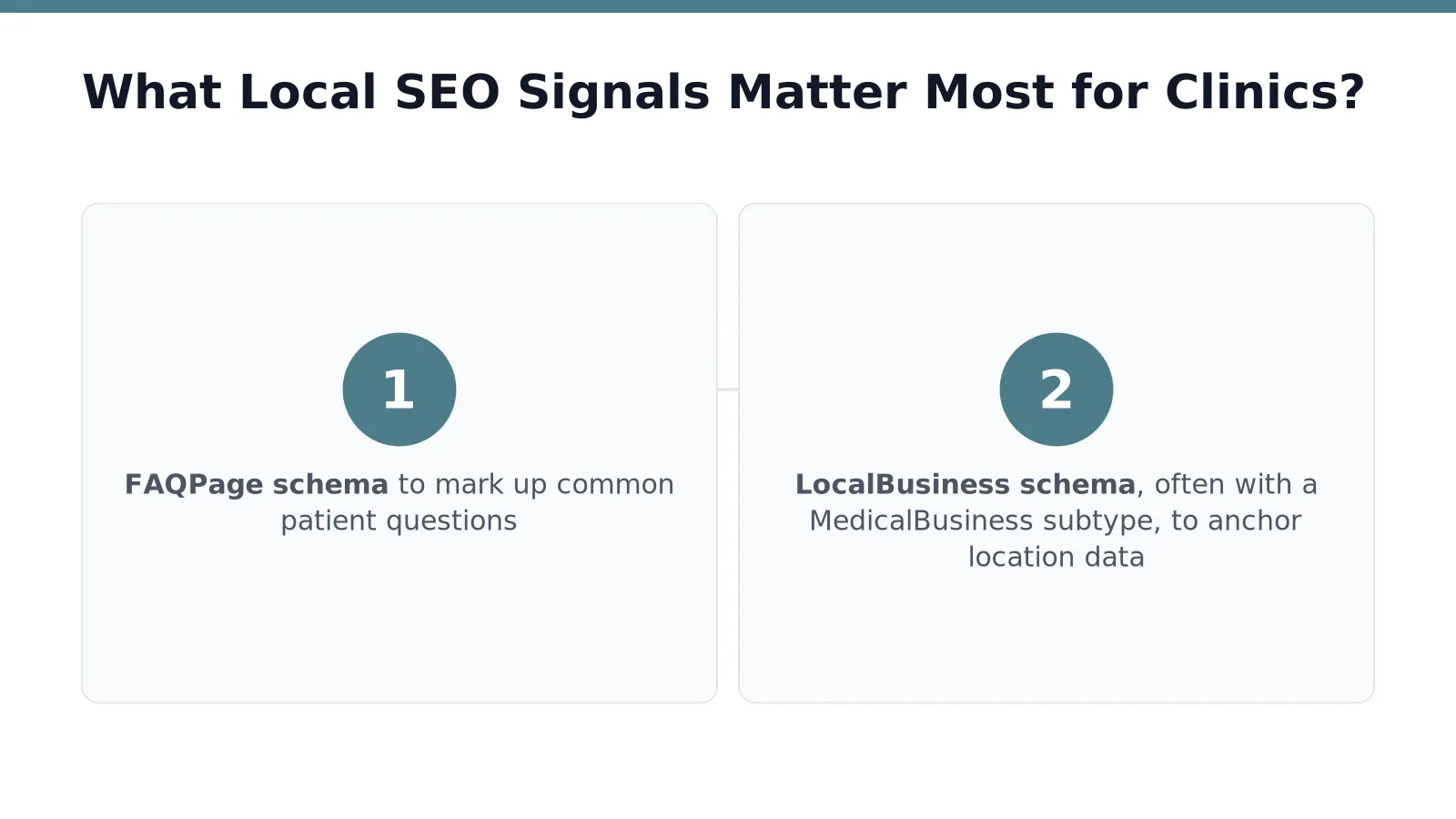
  1. FAQPage schema to mark up common patient questions
  2. LocalBusiness schema, often with a MedicalBusiness subtype, to anchor location data

Combined, these structured data types help search engines understand what a clinic offers and where it operates, translating directly into stronger placement for mental health SEO strategies.

Does mobile search change how clinics should prioritize local SEO?

Mobile behavior changes everything. More than half of paid health-related search clicks, 53 percent, now come from mobile devices. A clinic's local listing must load fast, display accurate hours, and show verified reviews on a small screen, not just a desktop browser.

Reviews complete the picture. Combined with optimized profiles and schema, they build the trust signals search engines and prospective patients both require before choosing a clinic.

How Can Clinics Earn Ethical Backlinks Safely?

Clinics earn credible links by building relationships through compliant, condition-specific channels rather than chasing volume. Safe ethical backlink acquisition for clinics depends on partnerships that respect confidentiality at every step. Quality outweighs quantity when a clinic's reputation and licensure are on the line.

Multi-location behavioral health groups face a layered compliance stack. Outreach efforts must account for HIPAA, 42 CFR Part 2, EKRA, and platform-specific health advertising restrictions simultaneously. A single misstep across any of these frameworks can expose a practice to regulatory risk, not just a lost link opportunity.

General digital marketing firms rarely understand this stack. We focus on agencies and partnerships built specifically for behavioral health. Specialty-focused outreach produces citations that actually hold up to scrutiny. Condition-specific directories, professional associations, and clinical publications carry more authority than broad business listings ever will.

What counts as an ethical backlink source for a mental health clinic?

Professional associations, accredited directories, and peer-reviewed publications qualify as ethical sources. Guest contributions to clinical journals or behavioral health networks also build legitimate authority. Avoid any directory that exchanges links for payment without editorial review.

Can client testimonials support backlink and citation strategies?

Yes, when gathered under informed consent and strict confidentiality safeguards. Testimonials collected through secure, compliant platforms function as trusted citations that reinforce a clinic's credibility online. HIPAA governs how any client story is used in outreach, requiring that personal health details stay protected throughout the process.

Clinics building sustainable, HIPAA-compliant backlink profiles should prioritize sources that match their clinical specialty over generic high-volume directories. Consider these safeguards before pursuing any partnership:

  • Verify the publisher maintains editorial standards, not pay-for-placement practices
  • Confirm no protected health information appears in any shared content
  • Document informed consent for every testimonial or case reference used
  • Select partners with direct relevance to behavioral or mental health care

Why Do Multi-Location Groups Need Different Strategies?

Multi-location mental health clinics compete in a different arena than single-site practices. Behavioral health SEO functions as a parent discipline, covering addiction treatment, mental health, eating disorder treatment, dual diagnosis, and trauma-focused care rather than one narrow niche. A clinic network rarely sits inside a single category. We build campaigns that recognize this overlap from day one.

Executives evaluating marketing partners at the portfolio level manage sites spanning more than one of these sub-verticals. Private equity backed groups, multi-modality regional networks, and hospital-affiliated behavioral health lines all share this reality. A strategy built for one service line alone leaves the rest of the portfolio underperforming.

Does ranking well for one specialty cover a whole clinic group?

No. An agency that ranks well for addiction treatment alone cannot be assumed to deliver the same results for mental health or trauma-focused services. Multi-location operators need mental health SEO strategies engineered across every clinical offering in the portfolio, not optimized for a single flagship location.

We design this work around four priorities for growing clinic groups:

  • Consistent location-level visibility across every clinic address
  • Service-line coverage that reflects the full behavioral health portfolio, not one niche
  • Mental health practice local SEO calibrated for each market independently
  • Compliance safeguards applied uniformly across every site

Why does multi-site growth demand a dedicated SEO approach?

High-growth mental and behavioral health facilities require strategies purpose-built for expansion, not templates borrowed from single-location practices. Each new clinic site adds search competition, local ranking factors, and reputation management requirements. We treat multi-site growth as its own discipline, aligning visibility work with the pace and complexity of the expansion itself.

How Do Landing Pages Convert SEO Traffic Into Bookings?

Landing pages turn search visibility into completed intakes by serving as the first point of contact between a prospective client and a mental health clinic. Design choices on that single page decide whether a worried visitor books an appointment or clicks away. We build these pages to balance warmth with clarity, since trust and conversion must coexist on the same screen.

Strong intake pages do more than greet visitors. They guide someone searching for anxiety or trauma support through a clear, low-friction path toward scheduling. We treat optimized client onboarding as a design discipline, not an afterthought. Every extra form field or confusing menu costs a clinic a booked session.

What makes an intake landing page actually convert?

Conversion depends on removing barriers between a search click and a confirmed appointment. Pages need appointment booking integration built in, so clients never leave the page to find a scheduler elsewhere. Mobile-responsive design matters just as much, since many people search for therapists on a phone during a stressful moment.

A functional intake page for a mental health clinic generally includes:

  • Direct appointment booking tools embedded on the page
  • Mobile-responsive layouts for seamless access across devices
  • Clear, reassuring language that supports lead generation without overpromising outcomes

Does landing page design work without an SEO strategy behind it?

No single page converts well in isolation. Lead generation results depend on pairing solid SEO fundamentals with ongoing content marketing. We also run regular growth audits of the client pipeline, tracking which pages actually produce booked clients rather than just traffic. That combination, page design plus sustained optimization, is what keeps a clinic's calendar full over time.

What Should Clinics Do Next to Grow Bookings?

Growth starts with three unglamorous priorities: profile accuracy, structured data, and reputation signals. Clinics ready to expand should audit these systems before spending another dollar on paid ads. Skipping this step wastes budget on traffic that never converts.

Mental Marketing Pros, operating from the United States, serves mental health clinics nationwide, regardless of state licensing lines or multi-location structure. We identify Google Business Profile optimization, schema markup, and client reviews as the three core local ranking signals clinics should keep prioritizing, season after season. These three levers, kept current, outperform most one-off marketing pushes.

Which local SEO signals matter most for clinic growth?

Google Business Profile accuracy, structured data markup, and review volume form the backbone of local visibility for behavioral health practices. Clinics that neglect any one of these three lose ranking ground to competitors who maintain all three consistently. Reviews, in particular, build trust with prospective patients comparing providers before intake.

How does scaling differ from basic visibility?

Visibility gets a clinic found. Scaling requires powerful, growth-oriented SEO services built specifically for expansion. Multi-location behavioral health facilities need infrastructure that supports a growing patient volume, not just a single landing page.

Practices seeking real growth should evaluate readiness across these dimensions:

  • Profile completeness: hours, services, and insurance details current across every location
  • Structured data: schema markup supporting rich snippets and local search clarity
  • Review cadence: steady, HIPAA-compliant collection of patient feedback
  • Dual audience design: digital spaces serving both urgent seekers and cautious researchers

A clinic standing out must remain visible and welcoming simultaneously, meeting the person booking tonight and the one still comparing providers next week.

FAQ

Why do mental health clinics need specialized SEO agencies?

Generalist marketing firms miss the emotional urgency behind mental health searches, where patients in crisis need trustworthy providers within minutes. Specialized agencies like Mental Marketing build strategies around HIPAA compliance and APA/ACA standards that generic vendors risk violating.

How do mental health searches differ from other healthcare searches?

Searchers compare psychologists and psychiatrists by evaluating credentials, reviews, and confidentiality signals rather than browsing casually. Google classifies this content under YMYL standards, requiring higher accuracy and trustworthiness than most business sectors.

What factors define a top mental health SEO agency?

Four factors separate qualified partners from generalist vendors: clinical fluency, hands-on leadership, specialty focus, and measurable compliance discipline. Mental Marketing applies Schema.org vocabulary and compliant client acquisition tactics tailored specifically to mental health practices nationwide.

Conclusion

In closing, mental health clinics that prioritize SEO fundamentals, profile accuracy, structured data, and reputation signals, establish the infrastructure necessary for sustainable growth. Specialized strategies engineered for behavioral health practices outperform generalist approaches by honoring both compliance requirements and the emotional urgency underlying mental health searches. Clinics ready to expand must treat visibility and conversion as interconnected disciplines, not isolated tactics, ensuring that search traffic converts into booked appointments and sustained patient relationships across every location and service line.